Algae cooking oil
What Is Algae Oil? The Cooking Oil, Explained
By the editorial team · Updated 2026-11-25 · Every number linked to its source
Quick answer. Algae cooking oil is pressed from microalgae that are grown on sugar in closed fermentation tanks, then refined like other plant oils. The FDA-reviewed versions are about 87% oleic acid 14. It is a different product from the algal DHA oil sold as an omega-3 supplement.
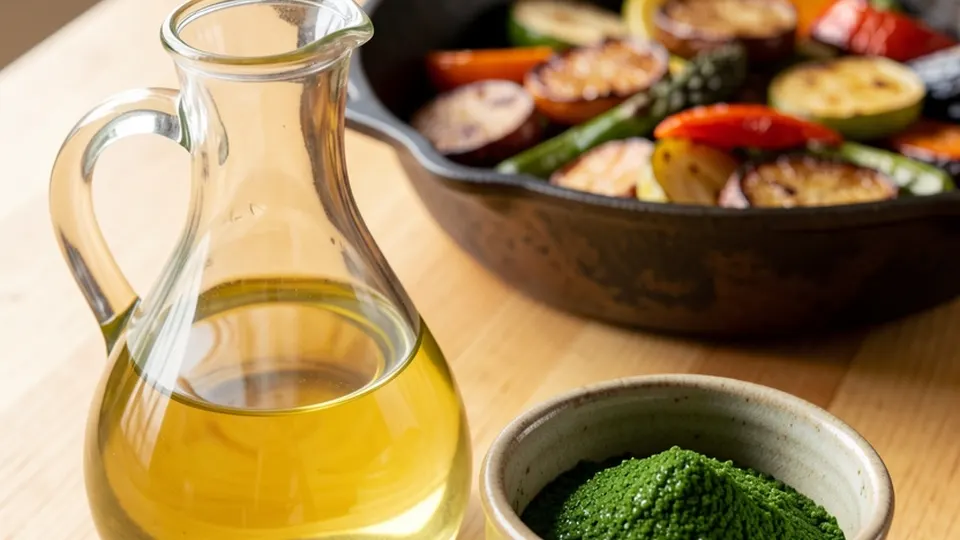
What is algae oil, exactly? The phrase covers at least three different products: a neutral cooking oil, an omega-3 supplement, and an ingredient in soaps and lotions. This page is about the first one, the bottle you might cook with, and it explains where it comes from, how it is made, who has sold it, and which parts of the story are documented versus only claimed.
The short answer is that algae cooking oil is a refined fat made by microscopic algae in a factory, not scraped off a beach or pressed from seaweed.
Microalgae, not seaweed
Seaweed and kelp are large, visible algae. The oil in your pan comes from microalgae: single cells too small to see. Algae Cooking Club says these cells can swell to as much as 80% of their weight in oil 1, which is a manufacturer figure rather than a measured one.
The documented species is Prototheca moriformis. FDA and Health Canada files describe high-oleic oils from two strains of it, S2532 and later S6697 2. Both were changed by classical mutagenesis plus targeted genetic modification so the cells would make mostly oleic acid, the same fat that dominates olive oil 3.
What is algae oil made from, step by step
The FDA safety dossier for the S6697 oil lays out the process 3:
- Fermentation. The algae grow in closed tanks and feed on sugar. The strain was given a yeast gene that lets it digest ordinary sucrose.
- Heat inactivation. The broth is heated so the cells are no longer alive.
- Drying. The biomass is drum-dried.
- Extraction. The oil is released mechanically.
- Refining. It is refined, bleached and deodorized, the standard "RBD" steps used for most supermarket oils.
Corbion, which owns the original technology, says its algae feed on cane sugar at a plant in Brazil beside a sugar cane mill 4. Health Canada adds that no algal DNA was detected in the finished oils and protein was below 0.1% 2.
How is algae oil made by today's brands?
Here the record gets thin. Algae Cooking Club describes fermentation in stainless steel tanks and lists its ingredients as "just algae oil + vitamin E" 5. Press coverage says a Brazilian manufacturer makes the oil, but does not name it 6.
That matters for two reasons. First, the safety reviews and fatty-acid data on file belong to the Corbion strains, so we cannot be sure they describe this bottle. Second, those strains are genetically engineered, and the brand has not said whether its strain is one of them. We list this as an open question rather than guess.
Three products called algae oil
Search results mix these up constantly, so here is how they differ.
| Product | Main fat | What it is for |
|---|---|---|
| High-oleic algae cooking oil | Oleic acid (omega-9) | Frying, roasting, baking, dressings |
| Algal DHA oil | DHA (omega-3) | Supplements, infant formula |
| Cosmetic or industrial algae oil | Varies | Lotions, soaps, massage oils, fuel research |
The DHA type comes from different organisms, such as Schizochytrium, and the FDA reviewed it separately for uses like infant formula 7. Algae Cooking Club states that its cooking oil contains no omega-3 at all and suggests separate capsules if you want it 1.
Wikipedia's entry shows how loosely the name travels across food, supplement and cosmetic uses 8.
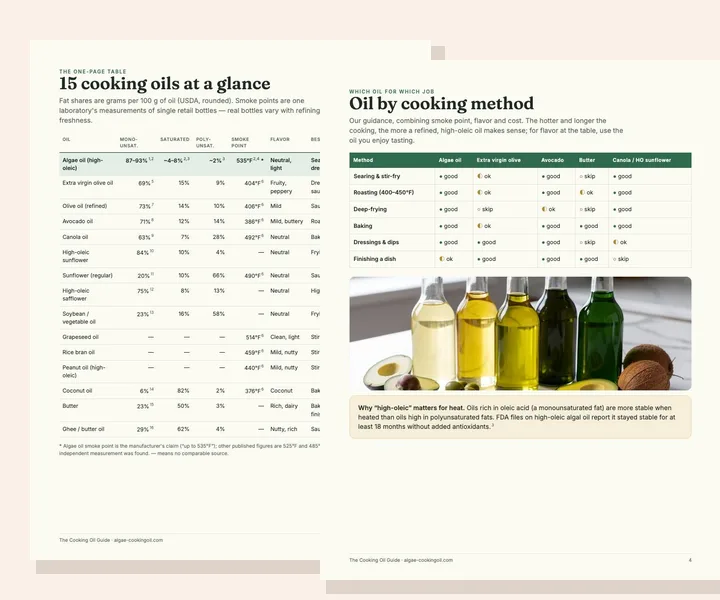
Free printable guide · 14 pages
Get The Cooking Oil Guide
The Cooking Oil Guide puts algae oil's documented facts and its open questions on one page, next to 14 other oils, so you can see what is proven before you buy.
- 15 oils on one page: fats, smoke points, best uses
- Which oil for searing, roasting, frying, baking, dressings
- Algae oil facts and open questions, with sources
- Label checklist, storage notes, 6 recipes · US Letter and A4
A short history of algae cooking oil
The company behind the science, Solazyme, was founded in 2003 9. Its first algal cooking oil, from a different alga called Chlorella protothecoides, cleared FDA GRAS review in 2012 10.
In October 2015 Solazyme launched Thrive, described at the time as the first culinary algae oil on the market, starting in a few Los Angeles stores 11. The company renamed itself TerraVia, filed for bankruptcy in 2017, and Corbion bought its assets 9.
Corbion ended Thrive in 2020 despite a rollout to more than 5,000 US stores, saying the brand had not reached the commercial success needed to continue 12. Wikipedia reports a 2024 relaunch of Thrive 9, which we could not confirm from any primary source.
Algae Cooking Club was founded in 2023 and launched publicly in February 2024, with chef Daniel Humm of Eleven Madison Park as culinary officer 6. By October 2024 it was in all 400-plus Sprouts stores 13. Retailers that carry it now are listed in where to buy algae cooking oil.
Regulatory status in brief
In the US, high-oleic algal oil entered the food supply through the GRAS notification route. The FDA closed GRN 527 in February 2015 14 and GRN 754 in July 2018 15, each with a letter saying it had no questions.
The GRN 754 dossier estimated intake at the 90th percentile of eaters at 27.47 g a day and covered use in many food categories, including vegetable oils and shortening 3.
Two details are easy to miss. The FDA says its use of the words "algal oil" in these letters is not an endorsement of that as the official name for ingredient labels 16. And not every algal ingredient is an oil: a separate notice covered a solid algal "structuring fat" for food manufacturing, which is not what you buy in a bottle. In Canada, Health Canada raised no objection to food use of the two high-oleic oils 2.
Environmental claims and what backs them
Much of the marketing is about sustainability. Algae Cooking Club says its oil has roughly half the carbon emissions of avocado, canola and olive oil and uses a fraction of their land and water 1. Its comparison table lists 1 kg of CO2-equivalent per kg of oil 5, with no methodology.
We found no peer-reviewed or third-party life-cycle study of high-oleic algal cooking oil. One factor any honest comparison must include is the sugar the algae eat, since that sugar is itself a farmed crop 4. The claims may turn out to be right, but for now they are unverified.
Taste and kitchen role
Both generations of the product were pitched as neutral. Solazyme called Thrive "very neutral, very light" 11, and the current brand adds a faint buttery, hazelnut note. That makes it a general-purpose oil rather than one you use for flavor. Methods and swaps are on how to cook with algae oil, and its heat claims are checked on the smoke point page.
Helpful in the kitchen
As an Amazon Associate we earn from qualifying purchases. Optional; nothing on this page needs it.
The algae oil sold today in US stores; read the label claims alongside the FDA figures on this page.
See it on Amazon ↗Frequently asked questions
What is algae oil made from?
It is made from the oil inside microalgae cells. In the process described in FDA files, the algae grow on sugar in closed tanks, are heat-treated and dried, and the oil is pressed out and then refined, bleached and deodorized 3. The current US brand adds vitamin E and lists nothing else on its ingredient line.
Is algae cooking oil vegan?
It is made by microalgae grown on sugar, with no animal ingredients in the process FDA files describe. Algae Cooking Club lists its ingredients as algae oil and vitamin E 5. We did not find an explicit vegan certification or statement from the brand, so if that label matters to you, check the bottle or ask the company directly.
Is algae oil bad for you?
Nothing in the regulatory record suggests harm at normal intakes. In a 90-day rat study reviewed by Health Canada, the highest dose tested, 5,200 mg per kg of body weight a day, showed no adverse effect 2. Long-term human data on this specific oil are lacking, and like any oil it is calorie-dense. Our health page covers the details.
Who makes algae cooking oil?
Algae Cooking Club, founded in 2023, is the main consumer brand in the US 6. Press coverage says a manufacturer in Brazil produces its oil but does not name it. Corbion, which owns the original Solazyme technology, sells algae oil to food companies rather than shoppers, after ending its Thrive brand in 2020 12.
Sources
- Algae Cooking Club, 2026: FAQ (answers embedded in page data)
- Health Canada, 2023: Novel Food Information: High Oleic Algae Oils from Prototheca moriformis strains S2532 and S6697
- U.S. FDA (notifier dossier by Burdock Group for TerraVia/Corbion), 2017: GRAS Notice (GRN) No. 754: Notification of GRAS Status of High-Oleic Algal Oil
- Corbion, 2026: AlgaVia culinary algae oils / Algae ingredients
- Algae Cooking Club, 2026: Algae Cooking Oil | Top Seller (product page)
- Green Queen, 2024: Can Microalgae Change the Way You Use Fat Forever? This Michelin-Starred Chef Thinks So
- U.S. FDA, 2017: Response letter GRN 000677 - Algal oil (DHA) from Schizochytrium sp. strain ONC-T18 (Mara Renewables)
- Wikipedia, 2026: Seaweed oil (algae oil / algal oil)
- Wikipedia, 2026: TerraVia
- U.S. FDA, GRAS Notice Inventory, 2012: GRN No. 384 - Algal oil derived from Chlorella protothecoides strain S106
- FoodNavigator-USA, 2015: Solazyme unveils Thrive, the first culinary algae oil in the market and its first consumer food brand
- FoodNavigator-USA, 2020: Corbion discontinues Thrive algae oil: 'We were not able to achieve the commercial success needed to sustain the brand'
- Nosh (press release), 2024: Algae Cooking Club Launches Nationally in Sprouts Farmers Market
- U.S. FDA, GRAS Notice Inventory, 2015: GRN No. 527 - Algal oil (87% oleic acid) derived from Prototheca moriformis strain S2532
- U.S. FDA, GRAS Notice Inventory, 2018: GRN No. 754 - Algal oil (87% oleic acid) derived from Prototheca moriformis strain S6697
- U.S. FDA, 2017: Response letter GRN 000673 - Algal fat derived from Prototheca moriformis (S7737)