Algae cooking oil
Is Algae Oil Healthy? A Careful Look at the Evidence
By the editorial team · Updated 2026-11-25 · Every number linked to its source
Quick answer. Algae oil has a fat profile most nutrition guidance favors: mostly oleic acid and very little omega-6, with linoleic acid around 1.5% in FDA dossier batches 1. It may carry the FDA's qualified health claim for high-oleic oils, but no long-term human studies on algae oil itself exist yet.
Compare two oils
Pick algae oil and any other oil in the compare tool to see their fat breakdown side by side, with the source for each number.
Fats: USDA FoodData Central (g per 100 g); algae oil: FDA GRAS file (brand label says 93% mono, ~4% saturated). Smoke points: one lab's measurements (De Alzaa 2018); * = manufacturer claim. 123456
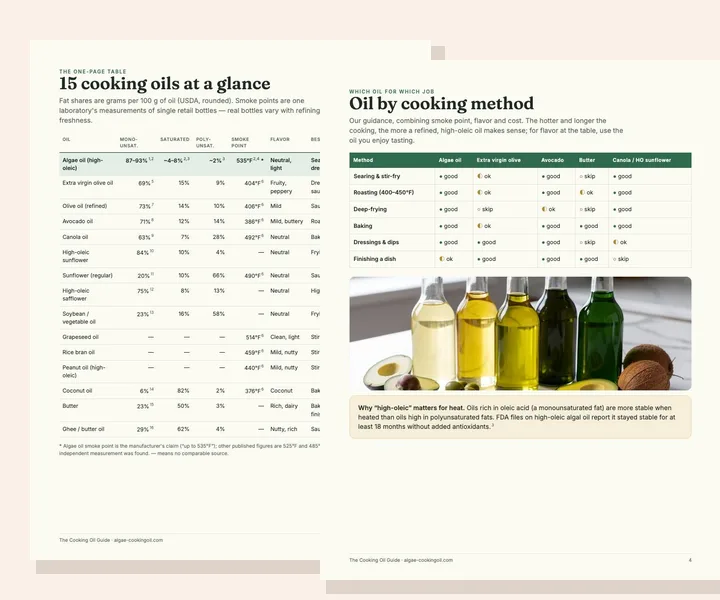
Want it on paper? The Cooking Oil Guide has all 15 oils on one printable page, with best uses and recipes.
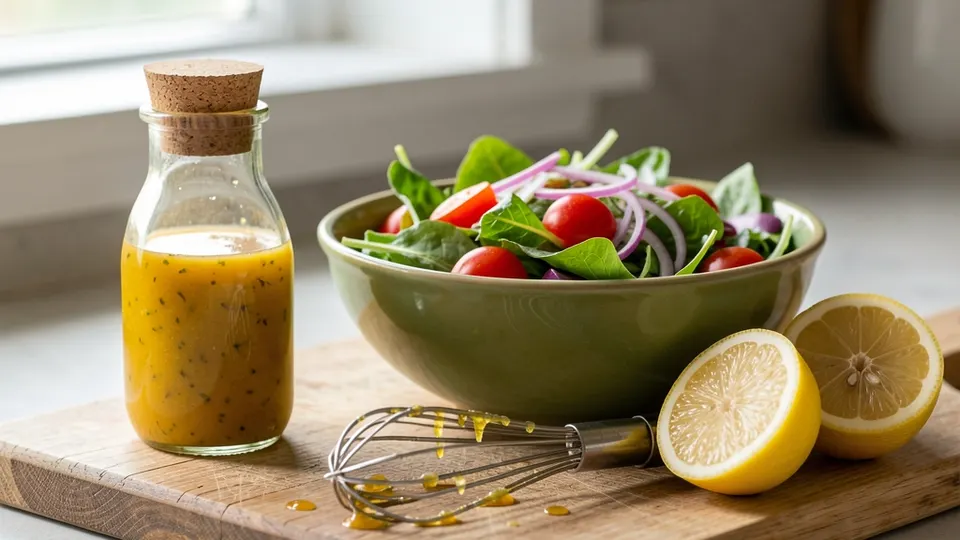
Is algae oil healthy, or just well marketed? The honest answer has three parts: what is in it, what regulators have said, and what nobody has studied. This page goes through each one. It is general information, not medical advice. If you have a heart condition, high cholesterol or a prescribed diet, your doctor or a registered dietitian is the right person to ask about fats.
What is in algae oil
Almost all of the fat is monounsaturated, mainly oleic acid. The FDA inventory names the two notified high-oleic algal oils "87% oleic acid" 7. Batch tests in the newer dossier came in slightly higher, with a mean of 88.27% oleic acid 1.
The brand number is higher still. Algae Cooking Club advertises 93% omega-9 fat and 13 g of it per tablespoon 2. Other monounsaturated fats might close part of that gap, but no published analysis shows how, so we report both figures.
Polyunsaturated fat is very low. Linoleic acid, the main omega-6, ranged from about 1% to 2% in FDA batch data, and alpha-linolenic acid was a fraction of a percent 1. For comparison, USDA lists ordinary soybean oil at 51 g linoleic acid per 100 g 6.
The saturated fat question
This is the biggest unresolved number. The brand lists 0.5 g of saturated fat per tablespoon 2, roughly 3.6% of a 14 g tablespoon, and Thrive claimed under 4% back in 2015 8.
Regulatory data point higher. FDA dossier batches averaged 8.06% saturated fat 1, and Health Canada's palmitic plus stearic values add up to about 7.2% to 9.7% 9.
Possible explanations include a different strain or process, or label rounding, but nobody has said which. Either way, algae oil is lower in saturated fat than olive oil, which USDA puts at 13.8 g per 100 g 10. It is simply not clear how much lower.
The FDA qualified health claim, word for word
Corbion, the company behind the original algal oil, petitioned the FDA, and in November 2018 the agency issued a letter of enforcement discretion covering oils that are at least 70% oleic acid 11. Olive oil qualifies, as do high-oleic versions of sunflower, safflower, canola and algal oil. Here is the permitted text:
"Supportive but not conclusive scientific evidence suggests that daily consumption of about 1½ tablespoons (20 grams) of oils containing high levels of oleic acid, when replaced for fats and oils higher in saturated fat, may reduce the risk of coronary heart disease. To achieve this possible benefit, oleic acid-containing oils should not increase the total number of calories you eat in a day." 11
Three phrases do the heavy lifting. "Not conclusive" is the FDA's own verdict on the evidence. "Replaced for" means swapping out a more saturated fat, not adding oil on top of what you already eat. And the calorie sentence rules out eating more overall. The FDA had first turned down an unqualified version because it did not meet the standard of significant scientific agreement 11. A salad dressing or a fried snack made with the oil cannot use the claim; only the bottled oil or an oil blend can.
What safety reviews found
The FDA closed GRAS reviews of high-oleic algal oil with no questions in 2015 7 and 2018 12.
Health Canada concluded the oils are as safe and nutritious as food containing other oils, found no mutagenic effects, and reported no adverse effect in rats at the highest dose tested 9.
On allergens, Health Canada measured protein below 0.1% 9 and saw no known allergen concern. These reviews answer the question "is the ingredient safe to eat?" They do not answer "does it improve health?", which is a different and harder question.
Free printable guide · 14 pages
Get The Cooking Oil Guide
The Cooking Oil Guide shows algae oil's disputed numbers next to the confirmed ones and lists the questions still open, so you can judge the health claims yourself.
- 15 oils on one page: fats, smoke points, best uses
- Which oil for searing, roasting, frying, baking, dressings
- Algae oil facts and open questions, with sources
- Label checklist, storage notes, 6 recipes · US Letter and A4
Is algae oil healthy long term? What is not known
We found no long-term human studies on algae cooking oil itself. The evidence behind the FDA claim comes from controlled studies of oleic acid in general, in which roughly 15 g a day of oleic acid replacing saturated fat lowered total and LDL cholesterol 11. Algae oil qualifies because of its oleic content, not because it was tested separately.
We also found no independent lab analysis of retail bottles, so the brand's 93% and 0.5 g figures 2 rest on its own testing. And the strain behind the main US brand is not public, which means the safety data on file may or may not describe the oil you buy.
Algae oil benefits: what is fair to say
Put the pieces together and a modest, defensible case emerges. Algae oil is a liquid fat that is mostly monounsaturated, very low in omega-6 and lower in saturated fat than olive or avocado oil. Those traits matter most when it takes the place of something else.
The FDA claim is built on exactly that idea: replacing fats higher in saturated fat. Butter, for example, carries 50.5 g of saturated fat per 100 g 13, and coconut oil 82.5 g 14. Cooking with algae oil instead of those fits the claim's logic. Pouring it on top of an unchanged diet does not, because every oil adds calories.
What is not fair to say is that algae oil is uniquely healthy, anti-inflammatory or heart-protective on its own. High-oleic sunflower, safflower and canola oils share much of the same profile and qualify for the same FDA claim, usually at a lower price.
The omega-3 myth
Because algae are the original source of the omega-3s in fish, many shoppers assume algae cooking oil is an omega-3 oil. It is not. Algae Cooking Club says its strain produces no omega-3 15. Omega-3 algae products are DHA oils made by other organisms and sold as supplements, as explained on what algae oil is.
Inflammation and the seed oil debate
Algae oil is often marketed as low in omega-6 and therefore less inflammatory. The low omega-6 part is true. The inflammation part assumes that omega-6 from foods drives inflammation, yet when clinical trials raised people's linoleic acid intake, a 2024 review found no increase in blood markers of inflammation or oxidative stress 16. The wider debate is on is algae oil a seed oil.
For how algae oil ranks against other options, see healthiest cooking oils.
Helpful in the kitchen
As an Amazon Associate we earn from qualifying purchases. Optional; nothing on this page needs it.
The algae oil sold today in US stores; read the label claims alongside the FDA figures on this page.
See it on Amazon ↗For dressings and gentle cooking, where its flavor shows.
See it on Amazon ↗Frequently asked questions
Does algae cooking oil have side effects?
No specific side effects are documented in the FDA or Health Canada reviews, and rats given the highest tested dose for 90 days showed no adverse effect 9. Like every oil it is pure fat, so large amounts add many calories. Anyone with an unusual reaction should stop using it and talk to a clinician, since human data on this oil are limited.
Can algae cooking oil replace fish oil or omega-3 pills?
No. Algae cooking oil is built around oleic acid, and the leading brand says it contains no omega-3 15. The algae oils that supply DHA are separate supplement ingredients made from other organisms. Swapping a cooking oil for a supplement would remove the omega-3 entirely, so any change to supplements is worth discussing with your doctor.
Is algae oil safe for people with food allergies?
Health Canada measured protein in the high-oleic algae oils at below 0.1% and identified no known allergen concern 9. Allergic reactions are usually triggered by proteins, which refining removes. That assessment covers the reviewed strains; the main US brand has not named its strain, so people with severe allergies should check the label and contact the maker.
Is algae oil good for your heart?
The FDA allows high-oleic oils, algal oil included, to carry a qualified claim that about 1½ tablespoons a day replacing fats higher in saturated fat may reduce coronary heart disease risk 11. The agency calls that evidence supportive but not conclusive, and it is not specific to algae oil. Treat it as a reasonable swap, not a treatment.
Sources
- U.S. FDA (notifier dossier by Burdock Group for TerraVia/Corbion), 2017: GRAS Notice (GRN) No. 754: Notification of GRAS Status of High-Oleic Algal Oil
- Algae Cooking Club, 2026: Algae Cooking Oil | Top Seller (product page)
- Acta Scientific Nutritional Health 2(6):02-11 (De Alzaa F, Guillaume C, Ravetti L; Modern Olives Laboratory Services, Australia), 2018: Evaluation of Chemical and Physical Changes in Different Commercial Oils during Heating
- USDA FoodData Central (SR Legacy), 2019: Oil, sunflower, linoleic, (approx. 65%) (FDC 171025)
- USDA FoodData Central (SR Legacy), 2019: Oil, safflower, salad or cooking, high oleic (FDC 171027)
- USDA FoodData Central (SR Legacy), 2019: Oil, soybean, salad or cooking (FDC 171411)
- U.S. FDA, GRAS Notice Inventory, 2015: GRN No. 527 - Algal oil (87% oleic acid) derived from Prototheca moriformis strain S2532
- FoodNavigator-USA, 2015: Solazyme unveils Thrive, the first culinary algae oil in the market and its first consumer food brand
- Health Canada, 2023: Novel Food Information: High Oleic Algae Oils from Prototheca moriformis strains S2532 and S6697
- USDA FoodData Central (SR Legacy), 2019: Oil, olive, salad or cooking (FDC 171413)
- U.S. FDA, 2018: Letter of enforcement discretion: qualified health claim, oleic acid in edible oils and reduced risk of coronary heart disease (Docket FDA-2017-Q-0807)
- U.S. FDA, GRAS Notice Inventory, 2018: GRN No. 754 - Algal oil (87% oleic acid) derived from Prototheca moriformis strain S6697
- USDA FoodData Central (SR Legacy), 2019: Butter, without salt (FDC 173430)
- USDA FoodData Central (SR Legacy), 2019: Oil, coconut (FDC 171412)
- Algae Cooking Club, 2026: FAQ (answers embedded in page data)
- PubMed Central (narrative review), 2024: Review on linoleic acid / n-6 PUFA and markers of inflammation and oxidative stress (PMC11600290)