Algae cooking oil
Algae Oil Smoke Point: What the Numbers Really Mean
By the editorial team · Updated 2026-11-25 · Every number linked to its source
Quick answer. The algae oil smoke point is advertised as up to 535°F (279°C) by Algae Cooking Club 2, but no brand has published a test method and no independent measurement exists. Older and retailer figures run lower, at 485°F and 525°F. Treat it as a high-heat oil with an unverified number.
Which oil for this job?
Choose a cooking method in the oil picker, such as searing or deep-frying, to see which oils suit it and which smoke point figures are measured rather than claimed.
Our kitchen guidance, based on smoke point, stability and flavor. 3
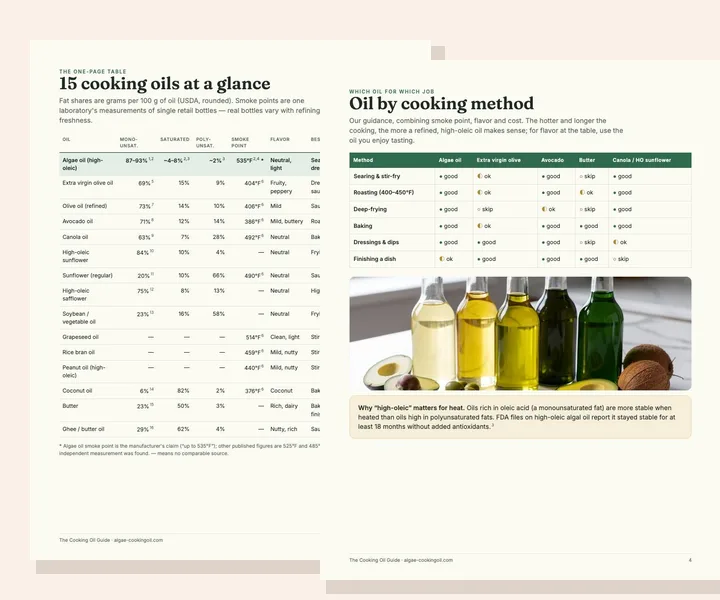
Want it on paper? The Cooking Oil Guide has all 15 oils on one printable page, with best uses and recipes.
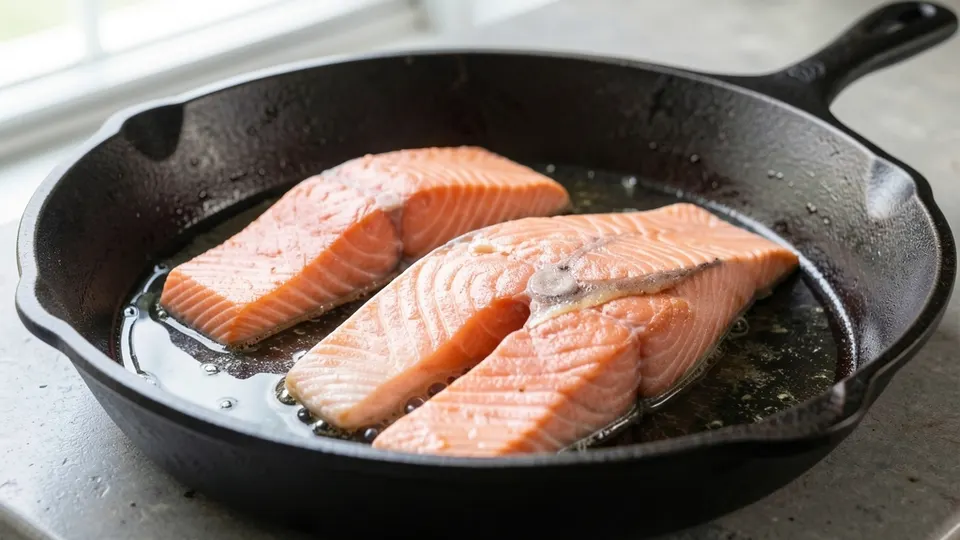
The algae oil smoke point is the headline of almost every product page: "up to 535°F," often called the highest of any cooking oil. That number may be right, but it has never been checked in public. This page lays out every figure we could find, explains why smoke points for the same oil can differ widely, and shows why the smoke point is only part of what makes an oil good for high-heat cooking.
Algae oil smoke point: three numbers for one oil
Here is what has been published for culinary algae oil:
| Figure | Who says it | Type of source |
|---|---|---|
| Up to 535°F (279°C) | Algae Cooking Club 2 | Manufacturer claim |
| 525°F (274°C) | Thrive Market blog, same product 7 | Retailer media |
| 485°F (252°C) | Thrive brand, 2015 8 | Company quote in press |
No test method is given for any of them. The FDA safety dossier on high-oleic algal oil contains detailed stability data but no smoke point at all 1.
The brand also says its oil smokes roughly 125°F higher than extra virgin olive oil 9, which fits with one lab's EVOO reading of about 404°F 3, though EVOO varies a lot from bottle to bottle.
Why smoke points vary
A smoke point is not a fixed property like a boiling point. A 2018 study of commercial oils found it depends mostly on free fatty acids, the loose fatty acids that build up as an oil ages or is less refined, and to a smaller degree on partial glycerides 3. How unsaturated the oil is made little difference; fatty-acid chain length mattered more.
The same study showed the effect clearly with olive oils. A virgin olive oil with 1.24% free fatty acids smoked at about 348°F, while a refined olive oil blend reached about 406°F 3. Smoke point also drops each time oil is reheated, so a bottle you reuse for frying will smoke earlier than a fresh one.
That explains why the older and newer algae figures could both be honest: different strains, refining and test setups produce different numbers. It also means none of them should be read as precise.
Smoke point is not the whole story
The most useful finding of the 2018 study was that smoke point did not predict how well an oil held up during heating 3. Better predictors were oxidative stability, ultraviolet readings that track breakdown products, and the share of polyunsaturated fat. Grapeseed and canola smoked later than extra virgin olive oil, for example, yet produced more breakdown products over a long heating run, because they carry more polyunsaturated fat.
One caveat: the lab that ran the study serves the olive industry, and it tested one brand of each oil. Still, the logic is sound and matches basic fat chemistry: monounsaturated fats oxidize more slowly than polyunsaturated ones.
Free printable guide · 14 pages
Get The Cooking Oil Guide
The Cooking Oil Guide includes an oil-by-cooking-method chart that marks which smoke points were measured and which are only claimed, so you know what to trust at high heat.
- 15 oils on one page: fats, smoke points, best uses
- Which oil for searing, roasting, frying, baking, dressings
- Algae oil facts and open questions, with sources
- Label checklist, storage notes, 6 recipes · US Letter and A4
What we know about algae oil's stability
This is where algae oil has real data on its side. High-oleic algal oil is mostly monounsaturated, with linoleic acid near 1.5% 1. In the FDA dossier, the oil stayed stable for at least 18 months at 5°C and 20°C with no added antioxidant, and its Rancimat oxidative stability index ran about 55 to 62 hours at 110°C 1.
Those are storage and accelerated-oxidation tests, not frying trials, and they describe the Corbion strain rather than any retail brand. But they point the same way as the fat profile: an oil this low in polyunsaturated fat should resist breakdown well. That, more than the 535°F headline, is the better reason to consider it for searing.
How other oils compare, by measurement
These smoke points were measured in the same 2018 lab study, so they are comparable with each other, though each comes from a single retail brand 3. Algae oil was not tested.
| Oil | Measured smoke point |
|---|---|
| Grapeseed oil | 514°F (268°C) |
| Canola oil | 492°F (256°C) |
| High-oleic peanut oil | 440°F (226°C) |
| Refined olive oil blend | 406°F (208°C) |
| Extra virgin olive oil | 404°F (207°C) |
| Avocado oil, unrefined | 386°F (197°C) |
Two notes. The study's canola and coconut columns were labelled ambiguously, so the canola figure is our best reading of the table. Marketing for refined avocado oil quotes higher numbers than this, but we found no lab measurement to back them. A longer chart with more oils is on high smoke point oils.
How to read a smoke point on a label
Smoke point figures appear on bottles, retailer pages and charts, and very few say where they came from. A few questions help sort them:
- Was it measured or quoted? A lab figure with a method is worth more than a round number in an ad.
- Which product? Refined and unrefined versions of the same oil can differ widely, as the olive oils above show.
- How old is the figure? The 485°F number for algae oil dates from a 2015 product made by a company that no longer sells oil to consumers 8.
- Who benefits? Manufacturer and retailer figures show that a claim is made, not that it was verified.
Applied to algae oil, every published smoke point fails the first test. That does not make the numbers false. It means the safe reading is "high, probably," not "535°F, exactly."
What this means at the stove
If you sear, stir-fry or roast hot, algae oil is a reasonable choice because of its low polyunsaturated fat, whatever its exact smoke point turns out to be. Preheat the pan, add oil just before the food, and lower the heat if the oil starts to smoke. Do not reuse frying oil many times; each round lowers its smoke point. Strain and cover oil you plan to reuse, and throw it out if it darkens, smells sharp or foams. Method-by-method tips are on how to cook with algae oil, and the comparison with olive oil continues on algae oil vs olive oil.
Helpful in the kitchen
As an Amazon Associate we earn from qualifying purchases. Optional; nothing on this page needs it.
The algae oil sold today in US stores; read the label claims alongside the FDA figures on this page.
See it on Amazon ↗Keeps frying oil in the right range instead of guessing from smoke.
See it on Amazon ↗Frequently asked questions
Is algae oil healthy for cooking?
For hot cooking, its main strength is chemistry rather than the advertised smoke point. With linoleic acid around 1.5% 1, it has little of the polyunsaturated fat that breaks down fastest under heat. No frying trial of retail algae oil has been published, so that advantage is expected rather than measured. Health questions are covered on is algae oil healthy.
Does algae oil have the highest smoke point of any oil?
A retailer blog calls its 525°F figure the highest of any cooking oil 7, but no measurement supports that ranking. The highest measured value in the 2018 lab comparison was grapeseed oil at about 514°F 3, and algae oil was not tested there. Until someone measures algae oil the same way, the ranking is a marketing claim.
What is the smoke point of algae oil in Celsius?
The brand's claim of up to 535°F converts to about 279°C 2. The 525°F retailer figure is about 274°C, and the 485°F quoted for Thrive in 2015 is about 252°C 8. All three are company or media figures without a disclosed test method, so the conversion is exact but the starting numbers are not verified.
Why do websites list different smoke points for algae oil?
They quote different products and sources. The 485°F figure belongs to the discontinued Thrive oil, while 535°F and 525°F describe the current brand from its own page and a retailer blog. Smoke point also shifts with refining, free fatty acids and test setup 3, so even honest figures for similar oils can differ.
Sources
- U.S. FDA (notifier dossier by Burdock Group for TerraVia/Corbion), 2017: GRAS Notice (GRN) No. 754: Notification of GRAS Status of High-Oleic Algal Oil
- Algae Cooking Club, 2026: Algae Cooking Oil | Top Seller (product page)
- Acta Scientific Nutritional Health 2(6):02-11 (De Alzaa F, Guillaume C, Ravetti L; Modern Olives Laboratory Services, Australia), 2018: Evaluation of Chemical and Physical Changes in Different Commercial Oils during Heating
- USDA FoodData Central (SR Legacy), 2019: Oil, sunflower, linoleic, (approx. 65%) (FDC 171025)
- USDA FoodData Central (SR Legacy), 2019: Oil, safflower, salad or cooking, high oleic (FDC 171027)
- USDA FoodData Central (SR Legacy), 2019: Oil, soybean, salad or cooking (FDC 171411)
- Thrive Market (A. Roberts), 2024: Algae Cooking Club algae oil (blog)
- Nutritional Outlook (J. Grebow), 2015: Will consumers accept algal oil as a cooking substitute?
- Algae Cooking Club, 2026: FAQ (answers embedded in page data)