Algae cooking oil
Is Algae Oil a Seed Oil? The Label, the Chemistry and the Research
By the editorial team · Updated 2026-11-25 · Every number linked to its source
Quick answer. No. Algae cooking oil comes from microalgae grown in fermentation tanks, not from plant seeds, so it is not a seed oil by origin. Its fat profile is also far from soybean or classic sunflower oil: FDA-reviewed batches averaged about 1.5% linoleic acid 6.
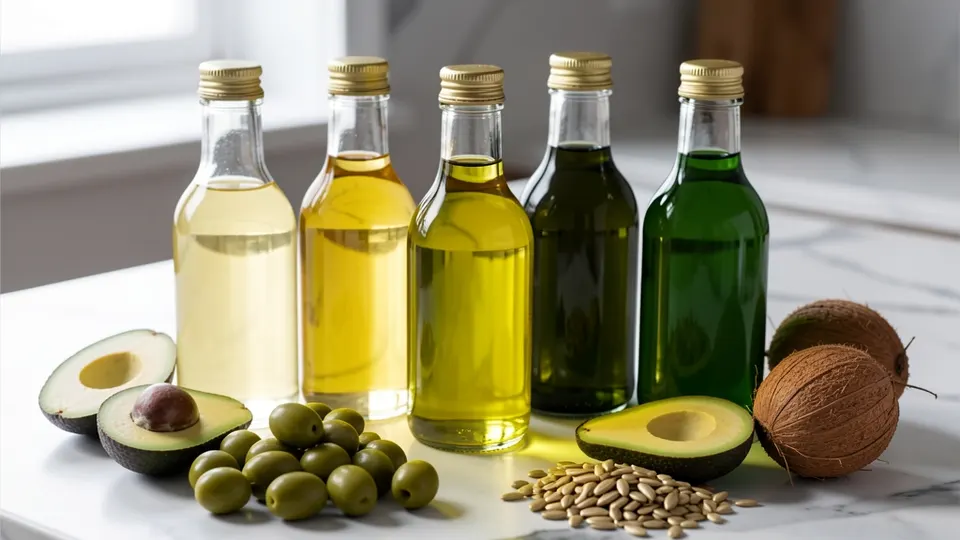
If you have started reading oil labels with the seed oil debate in mind, you have probably wondered: is algae oil a seed oil? The short answer is no. The longer answer is more useful, because the phrase "seed oil" mixes three separate questions: where an oil comes from, how it is processed and what fats it contains. Algae oil answers each of them differently. Below we look at what the term usually covers, why algae oil sits outside it, what the research on linoleic acid actually found and how much any of this should change what goes in your pan.
What people mean by "seed oils"
There is no regulatory definition of a seed oil 1. The term comes from food writing and social media, so lists vary. Algae Cooking Club, which sells algae oil and therefore has a stake in the answer, describes seed oils as oils pressed or extracted from plant seeds: soybean, canola, corn, sunflower, cottonseed, grapeseed and safflower, usually extracted with hexane and then refined. Coverage from the Harvard T.H. Chan School of Public Health names canola, corn and soybean as the main examples 2.
So yes, sunflower oil is normally on the list, and so is safflower. Olive and avocado oil are not, because they are pressed from the fruit rather than the seed. That distinction is about botany, not nutrition, which matters later.
When people say they avoid seed oils, they usually mean one or more of these concerns:
- Linoleic acid. Conventional soybean and sunflower oils are rich in this omega-6 fat.
- Processing. Solvent extraction, bleaching and deodorizing sound industrial.
- Where the oil shows up. Seed oils fill packaged snacks and fried fast food.
Each concern deserves its own answer, and algae oil does not pass or fail all three at once.
So, is algae oil a seed oil?
By origin, no. The oil comes from single-cell microalgae, not seaweed, that are grown in closed stainless steel tanks, a process the main US brand compares to brewing beer 3. The algal oils reviewed by the FDA come from strains of the microalga Prototheca moriformis 4. No seed is involved at any step.
The Seed Oil Free Alliance, a private certification body, lists algae oil as "not a seed oil" and allows it in its certified products 5. That is a classification by a commercial program, not a government ruling, but it reflects how most people use the term.
Processing is where the clean split ends. The FDA notification for the high-oleic algal oil describes fermentation, drying, mechanical extraction and then conventional refining, bleaching and deodorizing, "just like other plant oils" 6. If your objection to seed oils is refining itself, algae oil is a refined oil too. If your objection is solvent extraction, the FDA dossier describes mechanical extraction, though the leading brand does not publish its own process in that detail.
One more open point: Algae Cooking Club does not name its algae strain or its manufacturer, which is reported to be in Brazil 7. The FDA-reviewed strains are genetically engineered; whether the retail oil uses them is not public. You can read more about how the oil is made on our page on what algae oil is.
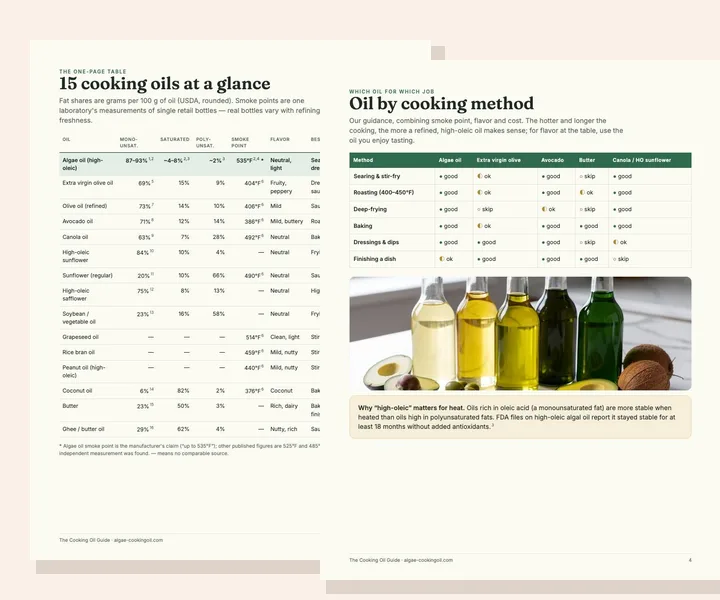
Free printable guide · 14 pages
Get The Cooking Oil Guide
The Cooking Oil Guide puts linoleic acid, oleic acid and saturated fat for 15 oils on one printable page, so you can judge any oil by its profile instead of its label.
- 15 oils on one page: fats, smoke points, best uses
- Which oil for searing, roasting, frying, baking, dressings
- Algae oil facts and open questions, with sources
- Label checklist, storage notes, 6 recipes · US Letter and A4
Fat profile matters more than the label
If linoleic acid is your concern, the seed label is a poor shortcut. Some seed oils have been bred to be low in it, and some fruit oils contain more than you might expect. Here is linoleic acid as a share of fat in a few oils.
| Oil | Linoleic acid | Source |
|---|---|---|
| High-oleic algal oil (FDA batch mean) | 1.53% | 6 |
| High-oleic sunflower oil | 3.61 g/100 g | 8 |
| Olive oil | 9.76 g/100 g | 9 |
| Canola oil | 19.0 g/100 g | 10 |
| Soybean oil | 51.0 g/100 g | 11 |
| Sunflower oil, classic linoleic type | 65.7 g/100 g | 12 |
High-oleic sunflower is a seed oil by any definition, yet it sits much closer to algae oil than to regular soybean oil. Olive oil, never called a seed oil, has several times more linoleic acid than the algal oil. Algae Cooking Club itself states linoleic acid below 3% on its comparison chart 13, which fits the FDA figure.
The practical lesson: if you want a low-linoleic oil, read the fat profile or the words "high oleic", not the seed or no-seed status.
What the research on linoleic acid shows
The seed oil worry rests mostly on linoleic acid. The research is more mixed and more reassuring than social media suggests, and it does not point in one direction only.
Start with the mainstream position. A 2009 science advisory from the American Heart Association concluded that omega-6 fats should supply at least 5 to 10% of daily energy, within its wider dietary advice 14. A 2018 Cochrane review of 19 randomized trials with 6,461 participants found that eating more omega-6 fat may make little or no difference to deaths or cardiovascular events, based on low-quality evidence, while it slightly lowered total cholesterol 15.
A 2019 pooled analysis of 30 cohort studies found that people with higher blood and tissue levels of linoleic acid had a lower risk of dying from cardiovascular disease, with a hazard ratio of 0.78 16. That is observational data, so it shows association, not cause.
The main counterpoint is a 2013 reanalysis of the Sydney Diet Heart Study. In 458 men who had already had a coronary event, replacing saturated fat with safflower oil was linked to more deaths: 17.6% versus 11.8% 17. The trial ran from 1966 to 1973 and the diet also included margarine, which limits how far it applies to today's kitchens.
On inflammation, a narrative review found that trials raising linoleic acid intake did not raise markers of inflammation or oxidative stress 18. In Harvard coverage, nutrition researcher Walter Willett places the blame for seed oil harms mostly on the ultra-processed and fried foods they end up in, rather than on the oils 2.
Taken together, the evidence does not show that seed oils are uniquely harmful. It also does not make an oil healthier simply because it avoids seeds.
Where algae oil fits in your kitchen
Algae oil makes sense if you want a neutral, high-oleic oil that sits outside the seed oil category, whether for personal preference or because you cook for someone who avoids seed oils. It is one of several high-oleic options, alongside olive oil and high-oleic sunflower or safflower oil.
Its low polyunsaturated content has a cooking upside that has nothing to do with the seed debate. When a 2018 lab study heated commercial oils for long periods, the ones richest in polyunsaturated fat degraded the most 19. That points toward high-oleic oils for long cooking, though no independent heating test of retail algae oil was found.
Two things algae cooking oil is not. It is not a source of omega-3: the brand says its strain produces none 3, and the algal DHA oils sold as supplements are a separate product. And it is not proven to be healthier than olive oil; for that comparison see algae oil vs olive oil and our overview of whether algae oil is healthy. If you are weighing all your options, our guide to the healthiest cooking oils sets out the criteria.
Helpful in the kitchen
As an Amazon Associate we earn from qualifying purchases. Optional; nothing on this page needs it.
The algae oil sold today in US stores; read the label claims alongside the FDA figures on this page.
See it on Amazon ↗A neutral high-oleic oil, close to algae oil in fat profile, usually at a lower price.
See it on Amazon ↗Frequently asked questions
Is algae oil high in omega-3?
No. Algae cooking oil is a high-oleic oil, meaning most of its fat is monounsaturated omega-9. Algae Cooking Club says the strain it uses produces no omega-3 at all 3. Algae-based DHA, the kind in supplements and infant formula, is a different oil from a different organism. If omega-3 is your goal, a cooking oil from algae will not supply it.
Is sunflower oil classified as a seed oil?
Yes, in the usual informal sense. Sunflower oil is pressed or extracted from seeds, and lists of seed oils almost always include it alongside soybean, canola, corn and safflower. There is no legal definition, though. Fat profile varies a lot: classic sunflower oil is about two-thirds linoleic acid 12, while high-oleic sunflower oil has only a few percent, closer to olive or algae oil.
What is the healthiest oil?
There is no single winner, and the seed or no-seed label is not a good way to pick one. Look at saturated fat, at whether the oil is high in oleic or linoleic acid, and at what it replaces in your cooking. Liquid plant oils used instead of butter or lard have the strongest evidence. Our guide to the healthiest cooking oils walks through those criteria with USDA figures.
What is the most unhealthy oil?
No oil category has been shown to be uniquely harmful, seed oils included. Research on linoleic acid is mixed but mostly reassuring, with a 2018 Cochrane review finding little or no effect on deaths 15. The bigger concerns are patterns: frying oil reused many times, heavy use of fats high in saturated fat, and diets built on ultra-processed fried food.
Is algae oil seed oil free?
Algae oil itself contains no seed oil, because it is made from microalgae grown by fermentation rather than from seeds. The Seed Oil Free Alliance, a private certification program, lists it as allowed. Check the ingredient list of any blend or prepared food, though, since a product can contain algae oil alongside other oils. The main brand's label shows nothing besides the algae oil and added vitamin E.
Sources
- Algae Cooking Club (T. J. Yamut, BSN, RN), 2025: Are seed oils bad for you?
- Harvard T.H. Chan School of Public Health (A. Roeder), 2025: Are seed oils healthful or harmful?
- Algae Cooking Club, 2026: FAQ (answers embedded in page data)
- U.S. FDA, GRAS Notice Inventory, 2018: GRN No. 754 - Algal oil (87% oleic acid) derived from Prototheca moriformis strain S6697
- Seed Oil Free Alliance (Seed Oil Free Certified), 2026: Is it a seed oil? Algae oil
- U.S. FDA (notifier dossier by Burdock Group for TerraVia/Corbion), 2017: GRAS Notice (GRN) No. 754: Notification of GRAS Status of High-Oleic Algal Oil
- Green Queen, 2024: Can Microalgae Change the Way You Use Fat Forever? This Michelin-Starred Chef Thinks So
- USDA FoodData Central (SR Legacy), 2019: Oil, sunflower, high oleic (70% and over) (FDC 172338)
- USDA FoodData Central (SR Legacy), 2019: Oil, olive, salad or cooking (FDC 171413)
- USDA FoodData Central (SR Legacy), 2019: Oil, canola (FDC 172336)
- USDA FoodData Central (SR Legacy), 2019: Oil, soybean, salad or cooking (FDC 171411)
- USDA FoodData Central (SR Legacy), 2019: Oil, sunflower, linoleic, (approx. 65%) (FDC 171025)
- Algae Cooking Club, 2026: Algae Cooking Oil | Top Seller (product page)
- Circulation 2009;119(6):902-907 (Harris WS et al., AHA science advisory), 2009: Omega-6 fatty acids and risk for cardiovascular disease
- Cochrane Database Syst Rev 2018;11:CD011094 (Hooper L et al.), 2018: Omega-6 fats for the primary and secondary prevention of cardiovascular disease
- Circulation 2019;139(21):2422-2436 (Marklund M et al., FORCE consortium), 2019: Biomarkers of Dietary Omega-6 Fatty Acids and Incident Cardiovascular Disease and Mortality
- BMJ 2013;346:e8707 (Ramsden CE et al.), 2013: Use of dietary linoleic acid for secondary prevention of coronary heart disease and death: Sydney Diet Heart Study recovered data and updated meta-analysis
- PubMed Central (narrative review), 2024: Review on linoleic acid / n-6 PUFA and markers of inflammation and oxidative stress (PMC11600290)
- Acta Scientific Nutritional Health 2(6):02-11 (De Alzaa F, Guillaume C, Ravetti L; Modern Olives Laboratory Services, Australia), 2018: Evaluation of Chemical and Physical Changes in Different Commercial Oils during Heating