Algae cooking oil
The Healthiest Cooking Oils, Judged by the Evidence
By the editorial team · Updated 2026-11-25 · Every number linked to its source
Quick answer. There is no single healthiest oil, but the evidence favors liquid oils low in saturated fat used in place of butter and other solid fats. FDA allows a qualified heart health claim for oils with at least 70% oleic acid, such as olive oil and high-oleic sunflower, safflower, canola and algal oil 14.
Cooking oils compared
Sort the oil table by saturated, monounsaturated or polyunsaturated fat to see how your pantry oils compare, with the source for every figure.
Tap a column to sort. Bars: green mono, amber saturated, blue poly.
Fats: USDA FoodData Central (g per 100 g); algae oil: FDA GRAS file (brand label says 93% mono, ~4% saturated). Smoke points: one lab's measurements (De Alzaa 2018); * = manufacturer claim. 123456
Want it on paper? The Cooking Oil Guide has all 15 oils on one printable page, with best uses and recipes.
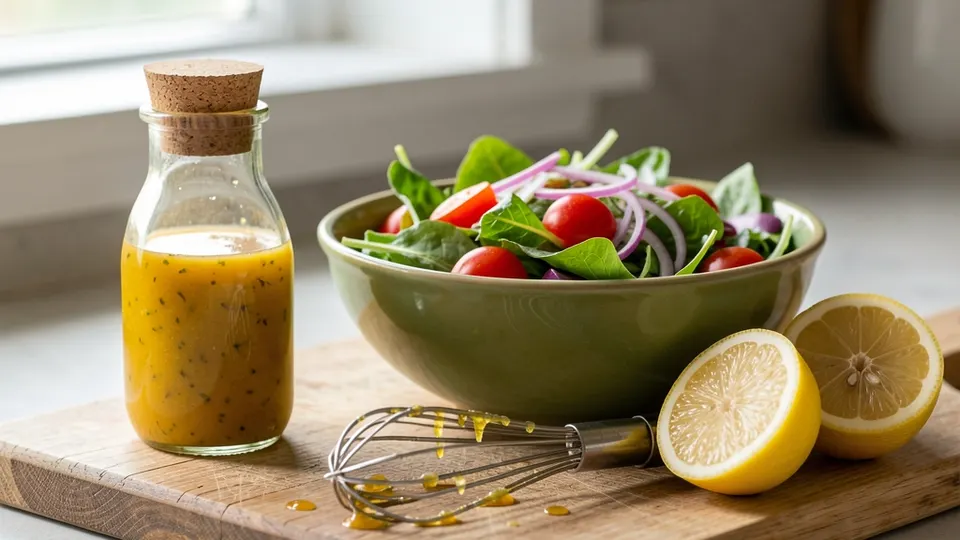
Lists of the healthiest cooking oils usually crown a winner, and the winner changes from site to site. The evidence does not support a single champion. What it does support is a short set of criteria you can apply to any bottle: how much saturated fat it contains, what kind of unsaturated fat dominates, what official bodies actually allow or recommend, and how the oil holds up in your cooking. This page walks through those criteria using USDA data and published guidance, then shows where the newer algae oil sits among the familiar choices.
How to judge the healthiest cooking oils
We use four questions, in this order.
- How much saturated fat does it have? Replacing saturated fat with unsaturated fat is the best-supported change in the research on cooking fats.
- What does the unsaturated fat consist of? Some oils are mostly monounsaturated oleic acid, others mostly polyunsaturated linoleic acid. Both have evidence behind them; the difference matters most for cooking stability.
- What do official bodies say? We look at FDA health claims and American Heart Association guidance rather than marketing.
- How will you cook with it? An oil that breaks down in your fryer or tastes wrong in your salad is not doing its job.
Amount also matters. All oils supply about the same calories per spoon, so a healthier oil is one that replaces a less healthy fat, not one you add on top.
Fat profiles of common cooking oils
These are USDA figures in grams per 100 g of oil. Rows do not add up to exactly 100 because of glycerol and other minor components.
| Oil | Saturated | Monounsaturated | Polyunsaturated | Source |
|---|---|---|---|---|
| High-oleic sunflower | 9.86 | 83.7 | 3.8 | 7 |
| Olive oil | 13.8 | 73.0 | 10.5 | 8 |
| Avocado oil | 11.6 | 70.6 | 13.5 | 9 |
| Canola oil | 7.36 | 63.3 | 28.1 | 10 |
| Soybean oil | 15.6 | 22.8 | 57.7 | 6 |
| Coconut oil | 82.5 | 6.33 | 1.7 | 11 |
For comparison, unsalted butter has 50.5 g saturated fat per 100 g 12, and anhydrous butter oil, the closest USDA entry to ghee, has 61.9 g 13.
The table shows why coconut oil and butter sit apart from the plant oils: most of their fat is saturated. Among the liquid oils, the main difference is which unsaturated fat leads. Canola and soybean oil carry more polyunsaturated fat, including the omega-3 ALA in canola. Olive, avocado and high-oleic sunflower oil are mostly monounsaturated.
The FDA heart claim for high-oleic oils
Only one official health claim covers oils by their fat type rather than by name. Since 2018 the FDA has allowed oils and oil blends with at least 70% oleic acid to carry a qualified heart claim 14. Olive oil and the high-oleic versions of sunflower, safflower and canola qualify, and so does high-oleic algal oil.
The word "qualified" matters. The claim opens with "Supportive but not conclusive scientific evidence suggests", and the possible benefit applies only "when replaced for fats and oils higher in saturated fat" and when the oil does "not increase the total number of calories you eat in a day" 14. In plain terms: swapping butter for one of these oils may help, adding oil to an unchanged diet does not. We give the full wording and its history on is algae oil healthy.
The 70% line sorts the oils in the table. In USDA data, olive oil has 71.3 g oleic acid per 100 g 8 and high-oleic sunflower 82.6 g 7, so both clear it.
Avocado oil, at 67.9 g 9, sits just under the line and was not named in the petition. Regular canola, at 61.7 g 10, falls short; only high-oleic canola qualifies. Soybean and coconut oil are far below.
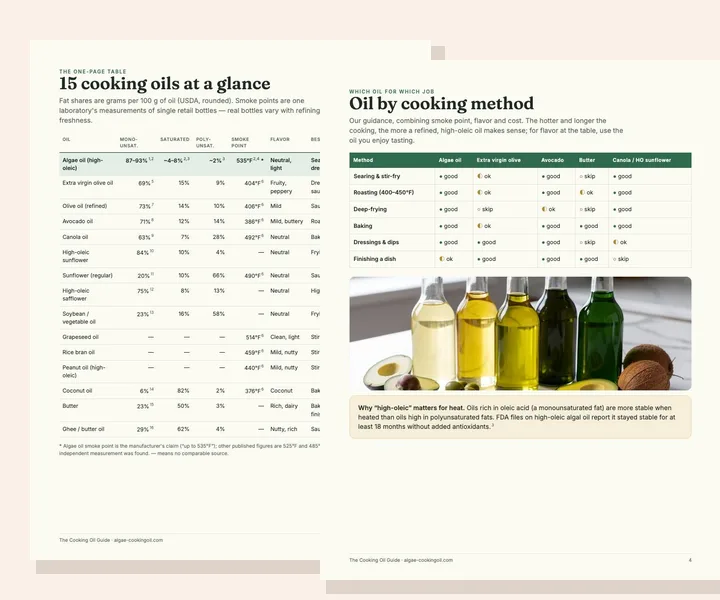
Free printable guide · 14 pages
Get The Cooking Oil Guide
The Cooking Oil Guide condenses this page into one printable table of 15 oils, with fat profile, smoke point and best uses for each, every number sourced.
- 15 oils on one page: fats, smoke points, best uses
- Which oil for searing, roasting, frying, baking, dressings
- Algae oil facts and open questions, with sources
- Label checklist, storage notes, 6 recipes · US Letter and A4
What the American Heart Association says about omega-6
Oils rich in linoleic acid, such as soybean and corn oil, often get blamed online. The American Heart Association reached the opposite conclusion in a 2009 advisory: it recommended getting at least 5 to 10% of calories from omega-6 fats 15. A 2018 Cochrane review found little or no effect of extra omega-6 on deaths or heart events, with low-quality evidence, and a small drop in total cholesterol 16.
In other words, both oleic-rich and linoleic-rich liquid oils have support as replacements for saturated fat. We look at the seed oil debate in more detail on is algae oil a seed oil.
What "healthy" cannot mean
No oil is healthy in isolation. A spoonful of any oil is mostly fat and calories, and none of the evidence above says that adding oil to your diet improves health. The benefits in the research come from substitution: liquid plant oil instead of butter, lard or coconut oil.
The food around the oil also matters. A deep-fried snack is not made healthy by switching the frying oil, and a salad is not made unhealthy by a spoonful of soybean oil dressing. The overall pattern of your diet outweighs the choice between two liquid oils.
Finally, how you cook changes things. Heat wears down polyunsaturated fats faster than monounsaturated ones, which a 2018 comparison of commercial oils confirmed for long heating 3. For frying, a high-oleic oil is the steadier choice; for salad dressings, stability matters less. Our high smoke point oils chart covers heat in detail.
Where algae oil sits
Algae oil is not in the USDA database, so its figures come from the FDA dossier and the brand. FDA batch data for high-oleic algal oil show 88.27% oleic acid and 8.06% saturated fat 1. Algae Cooking Club states 93% omega-9 and 0.5 g saturated fat per tablespoon, which works out to roughly 4% 2. The gap is unresolved, so we give both.
Either way, algae oil belongs with the high-oleic group, closest in profile to high-oleic sunflower oil, and it is one of the oils named in the FDA claim petition. It contains essentially no omega-3, so it does not replace canola oil's ALA or the DHA in fish and algal supplements. Its health case rests on what is known about oleic acid in general, not on long-term studies of algae cooking oil itself.
For head-to-head numbers, see algae oil vs olive oil and algae oil vs avocado oil.
Helpful in the kitchen
As an Amazon Associate we earn from qualifying purchases. Optional; nothing on this page needs it.
For dressings and gentle cooking, where its flavor shows.
See it on Amazon ↗Refined avocado oil is the common alternative for high-heat cooking; check that the label says refined.
See it on Amazon ↗Frequently asked questions
Which oil do cardiologists recommend?
Ask your own doctor about your own heart. In published guidance, the message is consistent: cook with liquid plant oils instead of butter, lard or coconut oil. The AHA has recommended at least 5 to 10% of calories from omega-6 fats 15, which favors oils like soybean and canola, while the FDA heart claim covers high-oleic oils such as olive oil.
Is avocado oil better than olive oil?
Their fat profiles are close. USDA lists avocado oil at 70.6 g monounsaturated fat per 100 g 9 and olive oil at 73.0 g 8. Extra virgin olive oil has far more research behind it, while refined avocado oil is more neutral in flavor. Neither is clearly healthier; choose by taste, cooking method and how the oil was processed.
What is the best oil for deep frying?
A refined oil that is high in oleic acid and low in polyunsaturated fat. In a laboratory study of commercial oils, high-oleic peanut oil and extra virgin olive oil held up better during prolonged heating than canola, grapeseed or sunflower oil 3. Refined high-oleic sunflower, safflower and algae oil share that fat profile. Fry in batches and change the oil once it turns dark.
What is the unhealthiest oil to fry with?
Oil that has been reused many times is a poor choice whatever its type, because smoke point falls with repeated heating 3. Among fresh fats, those highest in saturated fat, such as coconut oil and butter, are the ones health guidance asks you to limit. Polyunsaturated-rich oils are not harmful as food but break down faster in long frying.
How do you dispose of used cooking oil?
Never pour it down the sink or toilet, where it can clog pipes. Let the oil cool completely, strain it if you plan to reuse it, and store it in a sealed container. To discard it, seal it in a container and put it in the trash, or check whether your city or a local recycling center collects used cooking oil.
Sources
- U.S. FDA (notifier dossier by Burdock Group for TerraVia/Corbion), 2017: GRAS Notice (GRN) No. 754: Notification of GRAS Status of High-Oleic Algal Oil
- Algae Cooking Club, 2026: Algae Cooking Oil | Top Seller (product page)
- Acta Scientific Nutritional Health 2(6):02-11 (De Alzaa F, Guillaume C, Ravetti L; Modern Olives Laboratory Services, Australia), 2018: Evaluation of Chemical and Physical Changes in Different Commercial Oils during Heating
- USDA FoodData Central (SR Legacy), 2019: Oil, sunflower, linoleic, (approx. 65%) (FDC 171025)
- USDA FoodData Central (SR Legacy), 2019: Oil, safflower, salad or cooking, high oleic (FDC 171027)
- USDA FoodData Central (SR Legacy), 2019: Oil, soybean, salad or cooking (FDC 171411)
- USDA FoodData Central (SR Legacy), 2019: Oil, sunflower, high oleic (70% and over) (FDC 172338)
- USDA FoodData Central (SR Legacy), 2019: Oil, olive, salad or cooking (FDC 171413)
- USDA FoodData Central (SR Legacy), 2019: Oil, avocado (FDC 173573)
- USDA FoodData Central (SR Legacy), 2019: Oil, canola (FDC 172336)
- USDA FoodData Central (SR Legacy), 2019: Oil, coconut (FDC 171412)
- USDA FoodData Central (SR Legacy), 2019: Butter, without salt (FDC 173430)
- USDA FoodData Central (SR Legacy), 2019: Butter oil, anhydrous (FDC 173412) - closest FDC entry to ghee
- U.S. FDA, 2018: Letter of enforcement discretion: qualified health claim, oleic acid in edible oils and reduced risk of coronary heart disease (Docket FDA-2017-Q-0807)
- Circulation 2009;119(6):902-907 (Harris WS et al., AHA science advisory), 2009: Omega-6 fatty acids and risk for cardiovascular disease
- Cochrane Database Syst Rev 2018;11:CD011094 (Hooper L et al.), 2018: Omega-6 fats for the primary and secondary prevention of cardiovascular disease