Algae cooking oil
High Smoke Point Oils: A Measured Chart and How to Use It
By the editorial team · Updated 2026-11-25 · Every number linked to its source
Quick answer. In a lab test of commercial oils, grapeseed, canola and sunflower oil had the highest measured smoke points, around 490 to 514°F 3. Smoke point alone does not predict how well an oil holds up to heat, though; oils low in polyunsaturated fat tend to be more stable over long cooking.
Cooking oils compared
Filter the oil table by smoke point, fat profile or best use; each figure shows whether it was measured in a lab or stated on a label.
Tap a column to sort. Bars: green mono, amber saturated, blue poly.
Fats: USDA FoodData Central (g per 100 g); algae oil: FDA GRAS file (brand label says 93% mono, ~4% saturated). Smoke points: one lab's measurements (De Alzaa 2018); * = manufacturer claim. 123456
Want it on paper? The Cooking Oil Guide has all 15 oils on one printable page, with best uses and recipes.
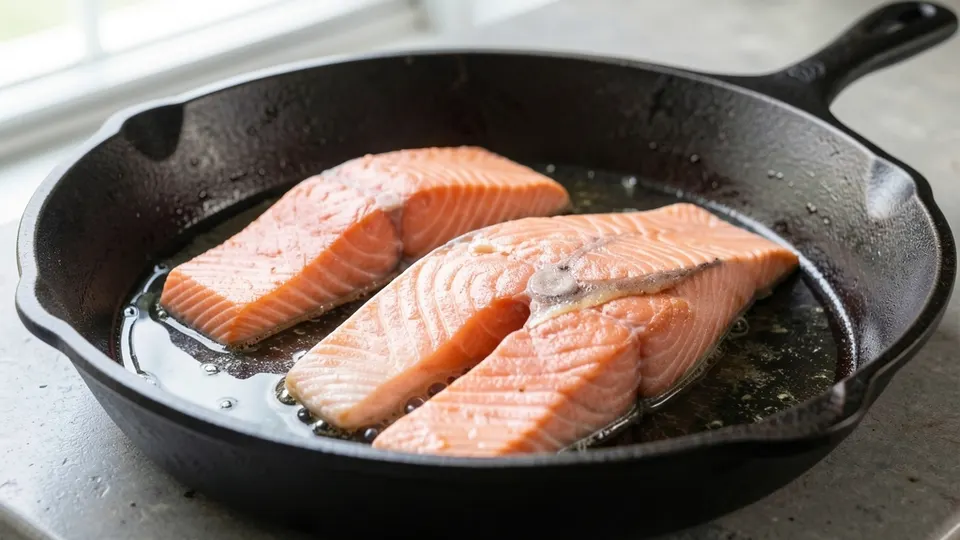
Most charts of high smoke point oils online copy the same numbers from one another, with no indication of where they came from. We took a different route: the figures below come from a single published laboratory study that measured retail oils side by side, with brand claims kept separate and labelled as claims. You will also see why smoke point varies so much between bottles of the same oil, why refining matters, and why the oil that smokes last is not always the one that holds up best in a hot pan.
What smoke point means, and what it does not
Smoke point is the temperature at which an oil starts to give off a steady, visible smoke under test conditions. Past that point, the oil is breaking down, flavors turn acrid and the kitchen fills with fumes.
The kind of oil matters less than you might think. What mostly sets the number is how much free fatty acid the bottle contains, which depends on how the oil was extracted and how far it was refined 3. So a chart can only ever describe the particular bottles that were tested, and the same oil from two producers can land tens of degrees apart.
Smoke point also falls each time oil is reheated, which matters if you reuse frying oil.
High smoke point oils: measured chart
We use one source for every row so the figures are comparable: a 2018 laboratory study that tested one retail brand of each oil 3. The study reports Celsius; the Fahrenheit column is our conversion.
| Oil | Smoke point °C | Smoke point °F |
|---|---|---|
| Grapeseed | 268 3 | 514 |
| Canola | 256 3 | 492 |
| Sunflower (about 50% linoleic) | 255 3 | 490 |
| Rice bran | 237 3 | 459 |
| High-oleic peanut | 226 3 | 440 |
| Olive oil, refined blend | 208 3 | 406 |
Further down the same study's list: extra virgin olive oil at about 207°C (404°F), and virgin olive oil last of all at about 175°C (348°F) 3.
At the lower end were an unrefined avocado oil at about 197°C (386°F) and coconut oil at 191°C (376°F) 3. Avocado oil's reputation as a high-heat oil rests on refined versions, and their label figures have not been matched by a published measurement we could find.
Two cautions. These are single samples from one lab, which is affiliated with the olive industry, so treat them as one set of measurements, not universal constants. And the canola and coconut columns in the original table share an abbreviation; the mapping we use follows the study's text and stability data.
Where algae oil fits on the chart
Algae oil is often sold as the highest-smoke-point cooking oil, but its figure has not been measured independently. Algae Cooking Club claims up to 535°F 2, and a Thrive Market blog about the same oil says 525°F 7.
In 2015 the maker of the earlier Thrive algae oil quoted 485°F 8.
None of these sources describes a test method, and the FDA safety dossier for high-oleic algal oil gives no smoke point at all. FDA batch data show free fatty acids of just 0.03% 1, and low free fatty acids go with higher smoke points, so a high figure is plausible, but plausible is not measured. Until someone publishes a test, the honest position is a range of brand claims with no measurement behind them. We cover the numbers and their gaps on our algae oil smoke point page.
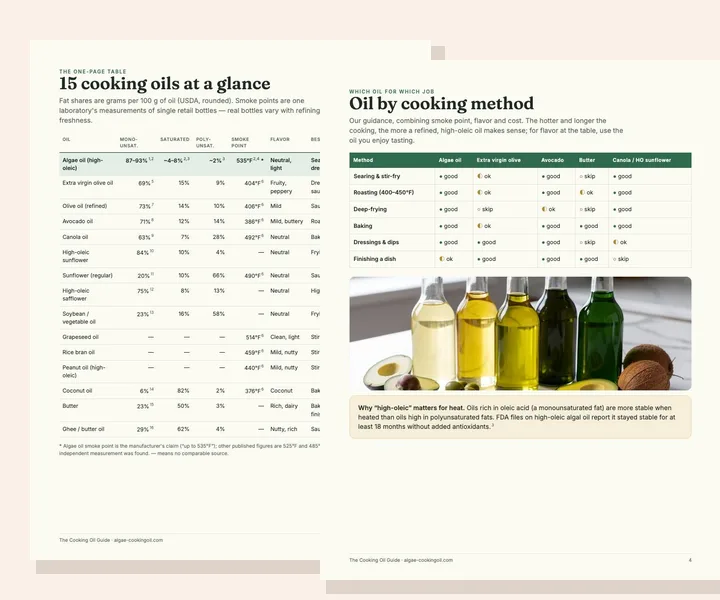
Free printable guide · 14 pages
Get The Cooking Oil Guide
The Cooking Oil Guide's one-page table lists 15 oils with smoke point, the source behind each figure and the cooking methods each oil suits best.
- 15 oils on one page: fats, smoke points, best uses
- Which oil for searing, roasting, frying, baking, dressings
- Algae oil facts and open questions, with sources
- Label checklist, storage notes, 6 recipes · US Letter and A4
Refined vs unrefined oils
Refining removes free fatty acids and other compounds that smoke early, so refined oils almost always have higher smoke points than their unrefined versions. Unrefined oils keep more flavor and color, which is why they are better suited to lower heat or finishing.
Olive oil shows the spread within a single crop: across three grades in the 2018 study, the gap between lowest and highest smoke point was close to 60°F, with the refined blend on top 3. Extra virgin oil ended up near the refined blend, because good extra virgin oil is low in free fatty acids to begin with. The algae oil smoke point page goes through the free fatty acid numbers.
When a label lists a single smoke point, ask which version of the oil it refers to. A figure for refined avocado oil says little about a cold-pressed bottle.
Stability matters as much as smoke point
Look again at the top of the chart. Grapeseed, canola, sunflower and rice bran, four of the five highest smoke points, are all rich in polyunsaturated fat, and in the same study they were the oils that degraded most during prolonged heating 3. The ranking by smoke point and the ranking by heat stability were not the same list.
That matters for how you cook. For a two-minute sear, a high smoke point is what counts. For an hour of batch frying, the slower breakdown of a high-oleic oil may count for more. Oils in that group include high-oleic sunflower and safflower, olive oil, high-oleic peanut and algae oil. Our page on the healthiest cooking oils explains the fat profiles behind this.
Best oil for high heat cooking, by method
Searing steak or fish. You need an oil that will not smoke the moment it hits a very hot pan. Refined, neutral oils from the upper part of the chart work, as do refined high-oleic oils.
Deep frying. Choose a refined high-oleic oil if you can, keep the temperature steady and change the oil once it darkens or begins smoking at lower heat.
Roasting and sauteing. Most cooking stays well below the measured smoke points of common oils, and extra virgin olive oil is a fine choice for everyday sauteing and roasting.
Stir-frying. Use a neutral refined oil and keep food moving. If the oil smokes before the food goes in, the pan is too hot.
For step-by-step tips on cooking with algae oil specifically, see how to cook with algae oil.
Helpful in the kitchen
As an Amazon Associate we earn from qualifying purchases. Optional; nothing on this page needs it.
Refined avocado oil is the common alternative for high-heat cooking; check that the label says refined.
See it on Amazon ↗A neutral high-oleic oil, close to algae oil in fat profile, usually at a lower price.
See it on Amazon ↗Keeps frying oil in the right range instead of guessing from smoke.
See it on Amazon ↗Frequently asked questions
What's a high smoking point oil?
There is no official cutoff, but cooks usually mean oils that do not smoke until well above normal sauteing temperatures. In one lab study, grapeseed, canola and sunflower oils all measured around 490°F or higher 3. Refined oils generally smoke later than unrefined ones. Brand figures, including the 535°F claimed for algae oil, are often higher than any independent measurement available.
Is olive oil safe at 450 degrees?
That is hotter than the smoke point measured for extra virgin olive oil in one lab study, which was about 404°F 3. Real pans have hot spots and bottles vary, so at 450°F you may see smoke. For that kind of heat, a refined oil is a better match. For most sauteing and oven roasting, extra virgin olive oil performs well and holds up to heat.
Will olive oil smoke at 400 degrees?
It might come close. One study measured extra virgin olive oil smoking at about 404°F and virgin olive oil at about 348°F 3. Fresher, higher-grade oil with fewer free fatty acids smokes later. An oven set to 400°F usually keeps food below that temperature, so roasting vegetables in olive oil at that setting is common practice. A dry pan on high heat is different.
What is the smoke point of peanut oil?
The high-oleic peanut oil tested in one laboratory study smoked at about 226°C, which is roughly 440°F 3. In that study it was also among the steadiest oils under long heating, a reason it is popular for frying. Unrefined or roasted peanut oils have more flavor and will smoke earlier, so check which type you are buying before planning a deep-fry.
What is the healthiest oil to cook with on high heat?
For high heat, look for an oil that is both refined and high in oleic acid. Oils low in polyunsaturated fat held up better during long heating in lab tests 3, and high-oleic oils also qualify for the FDA's heart health claim when they replace saturated fat. Refined high-oleic sunflower, safflower, peanut and algae oil all fit that description.
Sources
- U.S. FDA (notifier dossier by Burdock Group for TerraVia/Corbion), 2017: GRAS Notice (GRN) No. 754: Notification of GRAS Status of High-Oleic Algal Oil
- Algae Cooking Club, 2026: Algae Cooking Oil | Top Seller (product page)
- Acta Scientific Nutritional Health 2(6):02-11 (De Alzaa F, Guillaume C, Ravetti L; Modern Olives Laboratory Services, Australia), 2018: Evaluation of Chemical and Physical Changes in Different Commercial Oils during Heating
- USDA FoodData Central (SR Legacy), 2019: Oil, sunflower, linoleic, (approx. 65%) (FDC 171025)
- USDA FoodData Central (SR Legacy), 2019: Oil, safflower, salad or cooking, high oleic (FDC 171027)
- USDA FoodData Central (SR Legacy), 2019: Oil, soybean, salad or cooking (FDC 171411)
- Thrive Market (A. Roberts), 2024: Algae Cooking Club algae oil (blog)
- Nutritional Outlook (J. Grebow), 2015: Will consumers accept algal oil as a cooking substitute?