Algae cooking oil
How to Store Algae Oil and Keep It Fresh
By the editorial team · Updated 2026-11-25 · Every number linked to its source
Quick answer. Keep algae oil tightly capped in a cool, dark cupboard away from the stove; the fridge is optional. Sealed shelf life claims range from 12 to 24 months 1, and one retailer advises using an opened bottle within 12 months 3. Discard it if it smells like paint, crayons or stale nuts.
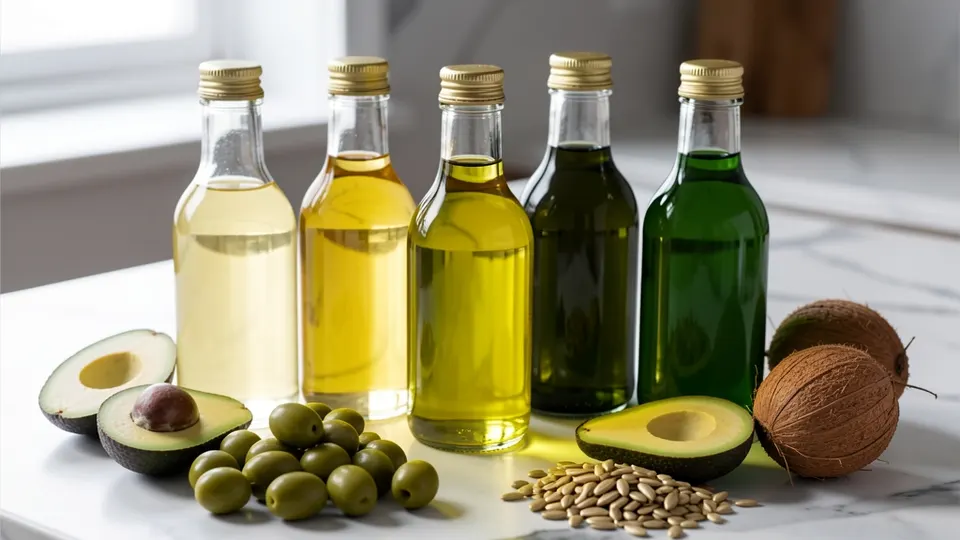
Knowing how to store algae oil is mostly about the three things that ruin any cooking oil: light, heat and air. The good news is that algae oil starts with an advantage, because it contains very little of the polyunsaturated fat that oxidizes fastest. The less good news is that shelf life figures for it vary between sources, and no independent storage test of the retail product has been published. Here is what each source says, how to set up your pantry and how to tell when a bottle has turned.
Does algae oil go bad?
Yes, eventually. Like every oil, it slowly oxidizes once it meets air, and oxidation is what makes oil taste rancid. The question is how fast.
The figures you will find disagree, so here they are side by side.
| What | Figure | Source |
|---|---|---|
| Sealed bottle, brand article | 12 to 24 months | 1 |
| Sealed bottle, another brand article | 2 years | 2 |
| After opening, retailer advice | Use within 12 months | 3 |
| Regulatory test, no added antioxidant | Stable 18+ months at 5 °C and 20 °C | 4 |
The last row comes from the FDA safety dossier for high-oleic algal oil made from a specific Corbion strain. It shows that this type of oil is stable at fridge and room temperature for well over a year, but it was not a test of the bottle in your kitchen, and the brand does not say whether it uses that strain.
A practical reading: an unopened bottle stored well should comfortably last a year, and once opened, aim to finish it within a year. Always check the best-by date printed on the bottle, and trust your nose over any chart.
How to store algae oil: light, heat and air
Light. Light speeds up oxidation. Algae Cooking Club packs its oil in aluminum bottles for that reason 1. If you decant oil into a clear cruet for the counter, fill it with only what you will use in a week or two and keep the main bottle in a cupboard.
Heat. The shelf above the stove or next to the oven is the worst spot in most kitchens. Choose a cupboard away from heat sources, dishwashers and sunny windows. The retailer's advice is simply a cool, dark place 3.
Air. Close the cap right after pouring. A half-empty bottle holds more air than a full one, so if you buy large bottles, consider a smaller one for daily use and refill it from the larger bottle.
Fat profile helps. In heating tests, oils high in polyunsaturated fat broke down faster than high-oleic oils 5. FDA batch data put linoleic acid in high-oleic algal oil at about 1.5% 4, so the same chemistry should work in its favor in the pantry, though storage itself has not been tested independently.
The only other ingredient Algae Cooking Club lists is vitamin E 6.
Should you refrigerate algae oil?
You do not need to. The FDA dossier found the high-oleic algal oil stable for at least 18 months at both 5 °C and 20 °C, roughly fridge and cool room temperature 4. A cool, dark cupboard does the job for most households.
The fridge can make sense if your kitchen runs warm, if you use oil slowly, or if you buy more than you will finish within a year. If you do refrigerate, take the bottle out a little before cooking, keep it tightly closed so it does not pick up fridge odors, and return it promptly.
The same logic applies to avocado, olive and other oils: cool and dark is the main rule, and the fridge is an option for slow users rather than a requirement.
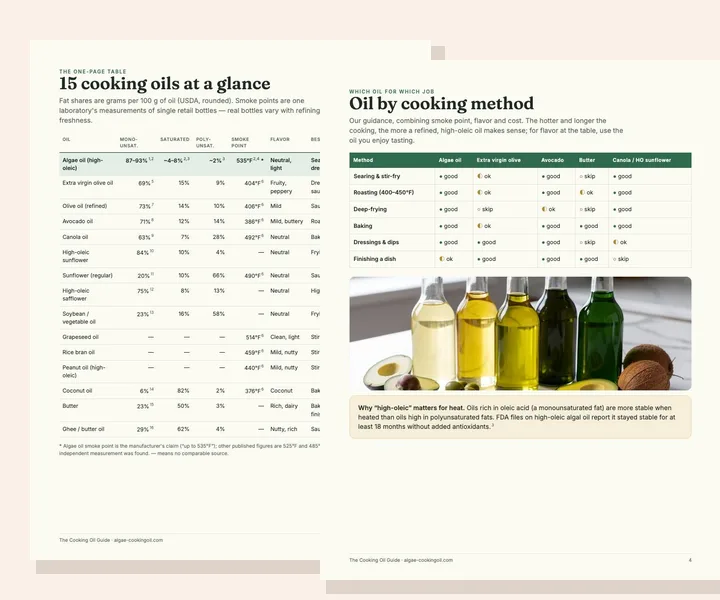
Free printable guide · 14 pages
Get The Cooking Oil Guide
The Cooking Oil Guide includes a storage page for 15 oils: where each one keeps best, how long it lasts and the signs it has turned.
- 15 oils on one page: fats, smoke points, best uses
- Which oil for searing, roasting, frying, baking, dressings
- Algae oil facts and open questions, with sources
- Label checklist, storage notes, 6 recipes · US Letter and A4
Signs your oil has gone rancid
Rancid oil is not usually dangerous in the small amounts you might taste, but it spoils the flavor of food and has lost quality. Check for:
- Smell. Fresh algae oil should smell of almost nothing. Rancid oil smells like crayons, oil paint, putty or stale nuts.
- Taste. A drop on a spoon tastes bitter, sharp or soapy rather than clean and mild.
- Look. Darker color or cloudiness that does not clear at room temperature can be a sign of age or contamination.
- Behavior in the pan. Oil that smokes much earlier than it used to has broken down.
If you are unsure, compare it with a fresh bottle. The difference is usually obvious.
A simple storage routine
If you want one routine to follow, this covers it:
- Write the opening date on the bottle with a marker.
- Keep the main bottle in a closed cupboard away from the stove, oven and windows.
- Pour what you need and close the cap straight away.
- Buy a size you will finish within a year of opening; a smaller bottle used up quickly beats a large one that sits.
- Smell the oil before cooking whenever it has been open for several months.
None of this is specific to algae oil, which is part of the appeal: it fits into the same pantry habits as any other cooking oil.
Reusing oil after frying
Frying oil can be reused a few times if you treat it well. Let it cool, strain out food particles through a fine sieve or coffee filter, and store it covered in a cool, dark place, separate from your fresh bottle.
Keep in mind that each round of heating lowers an oil's smoke point 5, so used oil will start smoking sooner. Discard it when it darkens noticeably, smells off, foams or smokes at normal frying temperatures. When you throw oil away, seal it in a container rather than pouring it down the drain.
For the cooking side of things, including swaps and simple recipes, see how to cook with algae oil. For how temperatures compare across oils, see the algae oil smoke point page, and if you are still choosing a bottle, our guide on where to buy algae cooking oil covers labels and packaging.
Helpful in the kitchen
As an Amazon Associate we earn from qualifying purchases. Optional; nothing on this page needs it.
Dark glass and a closed spout keep light and air off the oil.
See it on Amazon ↗Frequently asked questions
Is smoking oil too hot?
Yes. Once oil smokes steadily, it is breaking down, giving off acrid fumes and bitter flavors. Take the pan off the heat, let it cool slightly and continue at a lower setting. Reused oil smokes at lower temperatures than fresh oil, according to a lab study of commercial oils 5, so a smoking pan can also mean it is time to replace your frying oil.
Do I refrigerate avocado oil after opening?
It is not required. Like algae oil, avocado oil keeps well in a cool, dark cupboard with the cap tightly closed. Refrigeration can extend freshness if your kitchen is warm or you use the oil slowly, and some oils may turn cloudy when cold. That is harmless and clears at room temperature. Smell the oil before use if it has been open a long time.
How long does algae oil last after opening?
One retailer advises using algae oil within 12 months of opening 3, and storing it in a cool, dark place with the cap sealed. Brand articles quote 12 to 24 months for sealed bottles. How long yours lasts depends on heat, light and how much air sits in the bottle, so smell it before cooking if it has been open for many months.
Is algae oil inflammatory?
We found no studies of algae cooking oil and inflammation. What is known is that it is very low in linoleic acid, the omega-6 fat at the center of online inflammation worries, and a narrative review of trials found that higher linoleic acid intake did not raise inflammation markers 7. There is no direct evidence for the oil either way, and its low linoleic content gives no reason for concern on that point.
Which is healthier, avocado oil or algae oil?
Neither has been shown to be healthier in people. Algae oil has more oleic acid and, by most figures, less saturated fat, while avocado oil has a longer record and a USDA entry with 11.6 g saturated fat per 100 g 8. Algae oil is named in the FDA's high-oleic heart claim; avocado oil was not on that list. Our comparison page lays out the figures and their sources.
Sources
- Algae Cooking Club, 2024: Does avocado oil go bad?
- Algae Cooking Club, 2024: Does vegetable oil go bad?
- GroceryeShop (retailer listing), 2026: Algae Cooking Club Chef-Grade 100% Algae Cooking Oil
- U.S. FDA (notifier dossier by Burdock Group for TerraVia/Corbion), 2017: GRAS Notice (GRN) No. 754: Notification of GRAS Status of High-Oleic Algal Oil
- Acta Scientific Nutritional Health 2(6):02-11 (De Alzaa F, Guillaume C, Ravetti L; Modern Olives Laboratory Services, Australia), 2018: Evaluation of Chemical and Physical Changes in Different Commercial Oils during Heating
- Algae Cooking Club, 2026: Algae Cooking Oil | Top Seller (product page)
- PubMed Central (narrative review), 2024: Review on linoleic acid / n-6 PUFA and markers of inflammation and oxidative stress (PMC11600290)
- USDA FoodData Central (SR Legacy), 2019: Oil, avocado (FDC 173573)