Algae cooking oil
Algae Oil vs Avocado Oil: Which Should You Use?
By the editorial team · Updated 2026-11-25 · Every number linked to its source
Quick answer. Algae oil has more oleic acid and far less omega-6 than avocado oil, which USDA lists at 12.5 g linoleic acid per 100 g 7. Avocado oil has a longer track record and official nutrient data; algae oil's numbers come from FDA dossiers and brand claims. For neutral high-heat cooking either works.
Compare two oils
The compare tool is preset to algae oil and avocado oil; swap in any other oil to see how its fats and smoke point line up.
Fats: USDA FoodData Central (g per 100 g); algae oil: FDA GRAS file (brand label says 93% mono, ~4% saturated). Smoke points: one lab's measurements (De Alzaa 2018); * = manufacturer claim. 123456
Want it on paper? The Cooking Oil Guide has all 15 oils on one printable page, with best uses and recipes.
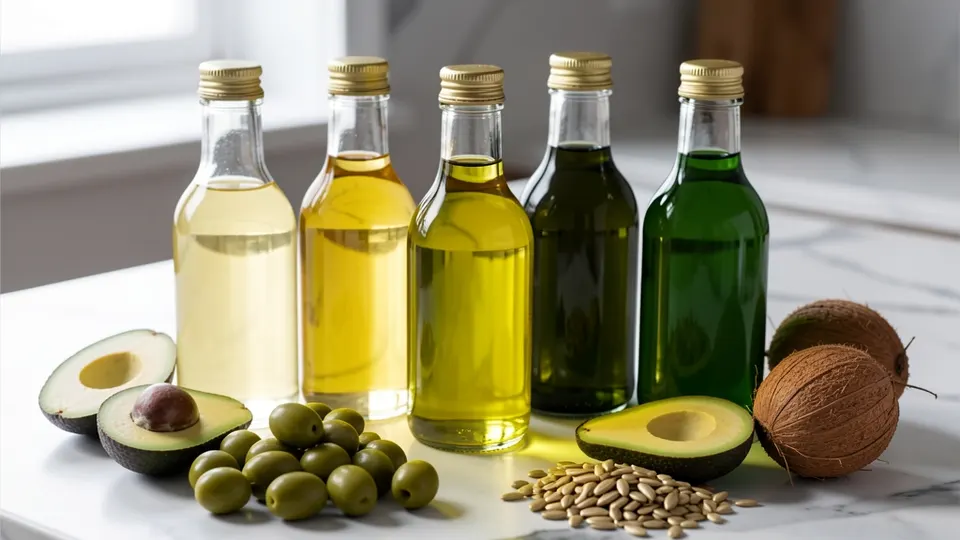
Algae oil vs avocado oil is the comparison most shoppers make, because both are sold as premium, high-heat alternatives to canola and soybean oil. They are closer than the marketing suggests. Both are mostly monounsaturated, both are refined for cooking, and both cost more than standard supermarket oils. The real differences are in the details: omega-6 content, how well each number is documented, and flavor.
Algae oil vs avocado oil: fats side by side
Avocado oil has a USDA entry; algae oil does not, so its figures come from regulatory dossiers and the brand.
| Fat | Algae oil (% of fatty acids) | Avocado oil (g per 100 g) |
|---|---|---|
| Oleic acid | 88.3% 1 | 67.9 g 7 |
| Linoleic acid (omega-6) | 1.5% 1 | 12.5 g 7 |
| Alpha-linolenic acid (omega-3) | 0.2% 1 | 1.0 g 7 |
| Saturated fat | 8.1% dossier, about 3.6% per brand label 1 | 11.6 g 7 |
The headline gap is omega-6. Avocado oil carries roughly eight times as much linoleic acid. Whether that matters for health is debated, and the evidence does not show that ordinary amounts of omega-6 from food are harmful; see is algae oil a seed oil for the studies.
Saturated fat favors algae oil either way, but by how much depends on which algae figure you trust. The brand's label implies about 3.6%, while FDA batch data averaged about 8% 1. Brand marketing says algae oil has 25% more omega-9 than avocado oil 8; against USDA data the gap is closer to a third, so the claim is approximate.
The FDA health claim threshold
The FDA's qualified health claim for oleic acid applies to oils with at least 70% oleic acid 9. Olive oil and the high-oleic forms of several crops, algal oil among them, were named as eligible. Avocado oil was not.
USDA's average avocado oil has 67.9 g of oleic acid per 100 g 7, just under the threshold. Some avocado oils may clear 70%, but the typical one sits slightly below it. This is a labeling technicality more than a health verdict: a few points of oleic acid are unlikely to change much on your plate.
Smoke point and heat
Both oils are sold for searing. Algae Cooking Club claims up to 535°F for its oil 2, a figure with no published test method. The only measured avocado oil we found, an unrefined one in a 2018 lab study, began smoking at about 386°F 3.
Refined avocado oils are marketed with much higher figures, but we could not find a measured source for them, so we do not repeat them here. In terms of stability, both are low in polyunsaturated fat, and algae oil is lower still, which suggests it should hold up at least as well in a hot pan. The full breakdown is on the algae oil smoke point page.
Flavor and texture
According to its maker, algae oil tastes mild, with a hint of butter and hazelnut, and leaves no greasy coating in the mouth 10. It is meant to disappear into a dish.
Avocado oil varies more. Refined versions are close to neutral, while unrefined ones keep more color and flavor from the fruit. We have no sourced tasting comparison between the two, so the best test is your own: try each in a simple vinaigrette, where differences show most.
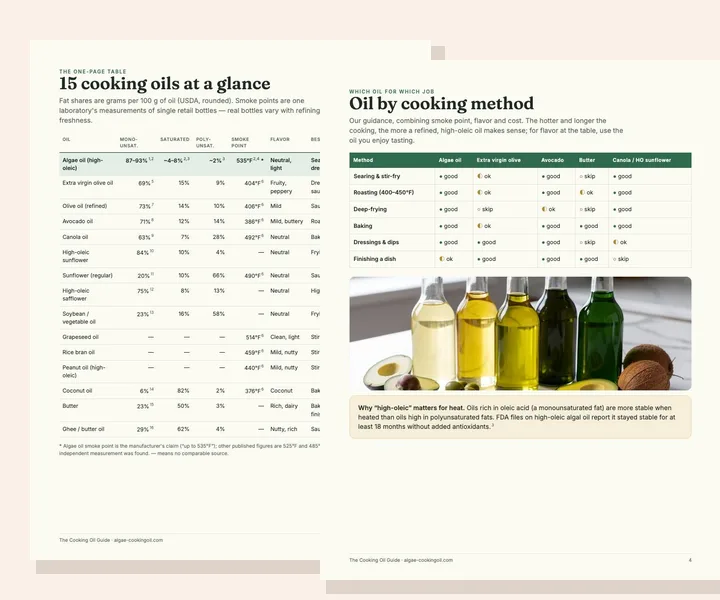
Free printable guide · 14 pages
Get The Cooking Oil Guide
The Cooking Oil Guide compares algae and avocado oil with 13 other oils in one sourced table, plus a shopping list for each cooking method.
- 15 oils on one page: fats, smoke points, best uses
- Which oil for searing, roasting, frying, baking, dressings
- Algae oil facts and open questions, with sources
- Label checklist, storage notes, 6 recipes · US Letter and A4
Track record and documentation
Avocado oil has a long history as a food and has a standard USDA nutrient profile. Algae oil as a consumer product dates only to 2015 11, and the first brand was discontinued in 2020 12.
Algae oil's safety record rests on FDA GRAS reviews and a Health Canada assessment of specific strains 13. The main US brand has not named its strain, and no independent lab has published a fatty-acid analysis of its oil. If documentation matters to you, avocado oil currently has the edge.
Sustainability claims
Algae oil brands often argue that avocado oil carries a heavy environmental cost. Algae Cooking Club rates avocado oil's impact as high in its own comparison table and claims its oil cuts emissions by about half compared with avocado oil 10. It gives no methodology for either claim.
We could not find an independent life-cycle assessment for algae cooking oil to test this. The algae are fed sugar from cane fields 14, so the comparison is crop against crop, not crop against nothing. If the environmental side drives your choice, treat both oils' footprints as unproven until a third party publishes numbers.
Cost and availability
We do not track prices, because they change often and differ by store. Both oils sit in the specialty tier, above canola and soybean oil. Avocado oil is sold almost everywhere; algae oil is in fewer stores, mainly natural grocers and online. Store options are on where to buy algae cooking oil. The fairest comparison is the per-ounce price on the shelf label. Bottle sizes differ between brands, so a smaller bottle can look cheaper while costing more per ounce.
Which should you pick?
Choose algae oil if you want the lowest omega-6 and saturated fat in a neutral oil, and you are comfortable with a newer product whose numbers come mostly from its maker and regulatory files.
Choose avocado oil if you prefer a longer track record, wider availability and official USDA data, or if you like the flavor of an unrefined bottle in dressings. For most home cooking, either will do the job. If you already own one, there is little reason to replace it before the bottle runs out; the differences show up over months of regular use, not in a single meal. Rotating oils is also a reasonable middle path. For a wider view, see healthiest cooking oils, and for the other common matchup read algae oil vs olive oil.
Helpful in the kitchen
As an Amazon Associate we earn from qualifying purchases. Optional; nothing on this page needs it.
The algae oil sold today in US stores; read the label claims alongside the FDA figures on this page.
See it on Amazon ↗Refined avocado oil is the common alternative for high-heat cooking; check that the label says refined.
See it on Amazon ↗Frequently asked questions
Is there a downside to avocado oil?
Avocado oil has more omega-6 and saturated fat than high-oleic oils, at 12.5 g and 11.6 g per 100 g in USDA data 7. The one unrefined avocado oil measured in a 2018 study smoked at about 386°F 3, lower than marketing for refined bottles suggests. Neither point makes it a poor oil; it simply is not unique.
Is sunflower oil healthier than avocado oil?
Is avocado oil or coconut oil better for you?
Coconut oil is mostly saturated fat, 82.5 g per 100 g in USDA data 16, while avocado oil has 11.6 g 7. The FDA's oleic acid claim is framed around swapping out fats that are more saturated. Coconut oil works for specific recipes, but avocado oil fits better with guidance that favors unsaturated fats.
What are the top 3 healthiest oils?
No ranking fits everyone, because the best oil depends on the dish and the rest of your diet. One useful filter is the FDA's 70% oleic acid line for its qualified heart claim 9, which olive oil and several high-oleic oils meet. Our healthiest cooking oils page explains how we compare them.
Sources
- U.S. FDA (notifier dossier by Burdock Group for TerraVia/Corbion), 2017: GRAS Notice (GRN) No. 754: Notification of GRAS Status of High-Oleic Algal Oil
- Algae Cooking Club, 2026: Algae Cooking Oil | Top Seller (product page)
- Acta Scientific Nutritional Health 2(6):02-11 (De Alzaa F, Guillaume C, Ravetti L; Modern Olives Laboratory Services, Australia), 2018: Evaluation of Chemical and Physical Changes in Different Commercial Oils during Heating
- USDA FoodData Central (SR Legacy), 2019: Oil, sunflower, linoleic, (approx. 65%) (FDC 171025)
- USDA FoodData Central (SR Legacy), 2019: Oil, safflower, salad or cooking, high oleic (FDC 171027)
- USDA FoodData Central (SR Legacy), 2019: Oil, soybean, salad or cooking (FDC 171411)
- USDA FoodData Central (SR Legacy), 2019: Oil, avocado (FDC 173573)
- Algae Cooking Club, 2024: Does avocado oil go bad?
- U.S. FDA, 2018: Letter of enforcement discretion: qualified health claim, oleic acid in edible oils and reduced risk of coronary heart disease (Docket FDA-2017-Q-0807)
- Algae Cooking Club, 2026: FAQ (answers embedded in page data)
- FoodNavigator-USA, 2015: Solazyme unveils Thrive, the first culinary algae oil in the market and its first consumer food brand
- FoodNavigator-USA, 2020: Corbion discontinues Thrive algae oil: 'We were not able to achieve the commercial success needed to sustain the brand'
- Health Canada, 2023: Novel Food Information: High Oleic Algae Oils from Prototheca moriformis strains S2532 and S6697
- Corbion, 2026: AlgaVia culinary algae oils / Algae ingredients
- USDA FoodData Central (SR Legacy), 2019: Oil, sunflower, high oleic (70% and over) (FDC 172338)
- USDA FoodData Central (SR Legacy), 2019: Oil, coconut (FDC 171412)