Algae cooking oil
Algae Oil vs Olive Oil: An Evidence-Based Comparison
By the editorial team · Updated 2026-11-25 · Every number linked to its source
Quick answer. Compared with olive oil, algae oil is richer in oleic acid and lower in saturated fat; USDA lists olive oil at 13.8 g saturated fat per 100 g 7. Extra virgin olive oil, though, has decades of research behind it and real flavor. Many cooks keep both: algae oil for neutral high heat, EVOO for taste.
Compare two oils
The compare tool opens with algae oil and olive oil; switch to extra virgin or any other oil to see the differences line by line.
Fats: USDA FoodData Central (g per 100 g); algae oil: FDA GRAS file (brand label says 93% mono, ~4% saturated). Smoke points: one lab's measurements (De Alzaa 2018); * = manufacturer claim. 123456
Want it on paper? The Cooking Oil Guide has all 15 oils on one printable page, with best uses and recipes.
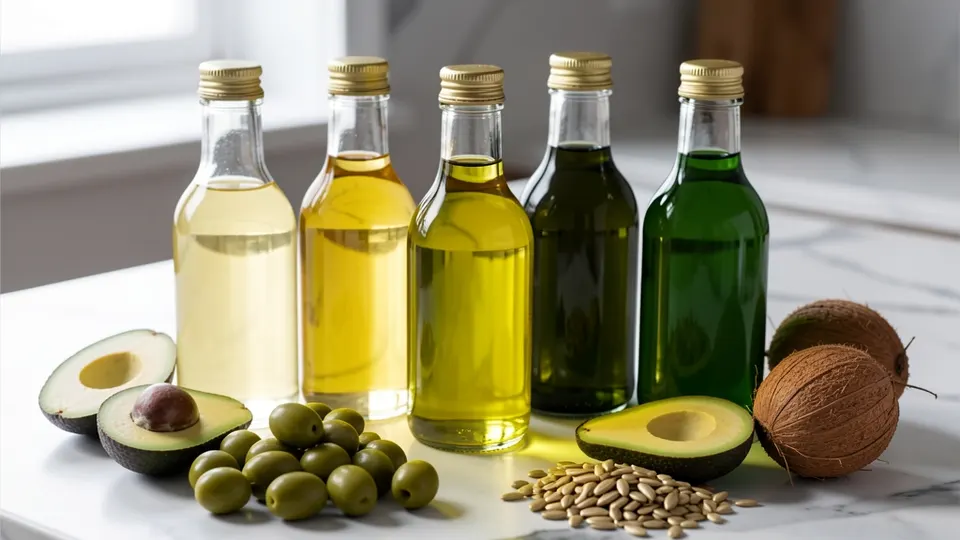
Algae oil vs olive oil is an odd matchup at first glance: one is a new product from fermentation tanks, the other one of the oldest foods in the Mediterranean diet. But they share a core trait. Both are built mostly from oleic acid, the monounsaturated fat that nutrition guidance tends to favor. Where they differ is everything around that core: saturated fat, flavor, evidence and price.
Algae oil vs olive oil: fat profiles
Olive oil figures are USDA grams per 100 g; algae oil comes from FDA dossier batch data, shown as a percentage of fatty acids.
| Fat | Algae oil | Olive oil | Extra virgin olive oil |
|---|---|---|---|
| Oleic acid | 88.3% 1 | 71.3 g 7 | 67.8 g 8 |
| Saturated fat | 8.1% 1 | 13.8 g 7 | 15.4 g 8 |
| Linoleic acid (omega-6) | 1.5% 1 | 9.8 g 7 | 8.4 g 8 |
The brand claims an even wider gap: 93% omega-9 fat and 0.5 g saturated fat per tablespoon 2. Those numbers conflict with the FDA dossier, and nobody has published an independent analysis to settle it.
How much less saturated fat?
Algae Cooking Club says its oil has 70% less saturated fat than olive oil on one page and 75% less on another 9. We checked the arithmetic. A tablespoon of USDA olive oil holds about 1.86 g of saturated fat, against the brand's 0.5 g, which is roughly 73% less 7. So the claim holds if you accept the brand's label.
If you use the FDA dossier's 8% figure instead, the gap shrinks to around 40% less than olive oil 1. Either way algae oil is lower; the size of the advantage is the open question. For context, the difference per tablespoon is around a gram or so of saturated fat, which matters more if you cook with oil heavily every day than if you use a spoonful now and then. The dispute itself is unpacked in is algae oil healthy.
Why this comparison keeps coming up
Algae oil has been positioned against olive oil from the start. Thrive, the first brand, advertised 75% less saturated fat than olive oil in 2015 10. In 2024 Algae Cooking Club announced a price cut in a press release framed around rising olive oil costs 11.
The chef connection adds to it. Eleven Madison Park, the New York restaurant led by the brand's culinary officer Daniel Humm, published a piece on why its kitchen uses algae oil 12. None of this is evidence about health or taste; it explains why you see the two oils compared so often. Keep in mind that a brand choosing olive oil as its rival tells you about its marketing, not about which oil suits your cooking.
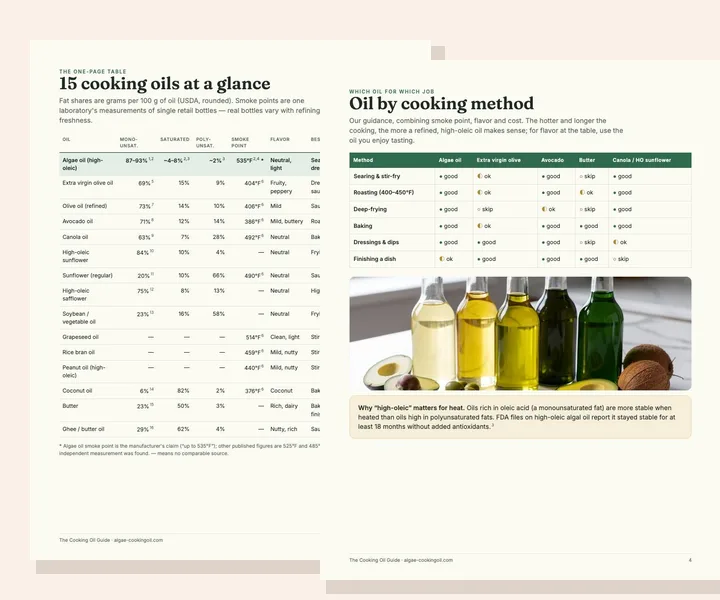
Free printable guide · 14 pages
Get The Cooking Oil Guide
The Cooking Oil Guide includes a one-page chart of which oil to use for each cooking method, with olive and algae oil placed side by side.
- 15 oils on one page: fats, smoke points, best uses
- Which oil for searing, roasting, frying, baking, dressings
- Algae oil facts and open questions, with sources
- Label checklist, storage notes, 6 recipes · US Letter and A4
Evidence behind each oil
This is olive oil's biggest advantage. Extra virgin olive oil has been studied for decades, in diet trials and large population studies. Algae cooking oil has nothing comparable. Its health case rests on its oleic acid content and on safety reviews of specific strains 13.
Both oils qualify for the FDA's 2018 qualified health claim for oils with at least 70% oleic acid, which lists olive oil and high-oleic algal oil among the eligible oils 14. That claim describes its own evidence as supportive but not conclusive. So on paper they share the same label; in practice, olive oil's evidence base is much larger.
Smoke point and stability
Olive oil is often said to be unsafe for high heat. The data are more nuanced. In a 2018 lab comparison, extra virgin olive oil started smoking near 404°F, about the same as refined olive oil, while a lower-grade virgin oil smoked near 348°F 3. More telling, EVOO formed fewer breakdown products over long heating than canola or grapeseed oil did.
On the algae side, the brand's 535°F figure, which it puts about 125°F above EVOO 9, has no published method. Even so, algae oil's very low polyunsaturated fat does suggest good heat stability. For hard searing or wok cooking, algae oil gives more margin; for sautéing and roasting at moderate heat, EVOO is fine. More on the algae oil smoke point page.
Flavor decides most of it
Algae oil is designed to taste like almost nothing. The brand calls it light and neutral and says plainly that it is not a finishing oil, recommending olive or sesame oil when you want flavor 9.
Extra virgin olive oil is the opposite: fruity, grassy or peppery depending on the bottle, and often the point of the dish. That makes the two more complementary than competing. A neutral oil lets delicate flavors come through in baking, mayonnaise or a fish sear; EVOO adds character to salads, bread, beans and finished plates.
Texture differs a little too. The brand says its oil leaves a round mouthfeel without a greasy film 2, which some cooks like in emulsions such as aioli. Olive oil can turn bitter when blended hard in a food processor, so many recipes for homemade mayonnaise call for a neutral oil anyway. Using algae oil there, and saving olive oil for where you can taste it, plays to the strengths of each.
When to use each
| Use | Better fit | Why |
|---|---|---|
| High-heat searing, stir-fry | Algae oil | Neutral, very low polyunsaturated fat |
| Baking, homemade mayo | Algae oil | No flavor to compete |
| Salad dressing, drizzling | Extra virgin olive oil | Flavor is the goal |
| Everyday sautéing, roasting | Either | Both handle moderate heat |
If you buy only one bottle, olive oil is the safer bet on evidence and price, and refined olive oil covers neutral cooking reasonably well. If you already cook with EVOO and want a dedicated high-heat neutral oil, algae oil is one option alongside high-oleic sunflower or safflower. Methods are on how to cook with algae oil; for avocado oil, see algae oil vs avocado oil.
Helpful in the kitchen
As an Amazon Associate we earn from qualifying purchases. Optional; nothing on this page needs it.
The algae oil sold today in US stores; read the label claims alongside the FDA figures on this page.
See it on Amazon ↗For dressings and gentle cooking, where its flavor shows.
See it on Amazon ↗Frequently asked questions
Is algae oil actually healthy?
Its fats look good on paper, and regulators in the US and Canada reviewed the ingredient as safe 13. What it lacks is research on health outcomes from eating algae oil itself, which olive oil has in abundance. It is a reasonable neutral cooking oil, not a proven upgrade. The full picture is on is algae oil healthy.
Can I use algae oil instead of olive oil?
Yes, for cooking you can swap it one for one by volume, since both are liquid oils of similar density. You will lose olive oil's flavor, which matters in dressings and drizzles but not in frying or baking. Algae oil also has less saturated fat, 0.5 g per tablespoon by the brand's label 2, though FDA data suggest more.
Does extra virgin olive oil break down at high heat?
Less than its reputation suggests. In a 2018 lab study, EVOO smoked at about 404°F but held up better over prolonged heating than canola, grapeseed and sunflower oils, which smoked later 3. The study was run by an olive-industry lab and tested one bottle of each oil, so it is a useful data point, not the final word.
Is olive oil a seed oil?
No. The term usually refers to oils pressed or extracted from plant seeds, with Algae Cooking Club's list naming soybean, canola, corn and sunflower among them 15. Olive oil comes from the fruit, and algae oil from microalgae, so neither fits. There is no legal definition of seed oil, and the wider debate is covered on is algae oil a seed oil.
Sources
- U.S. FDA (notifier dossier by Burdock Group for TerraVia/Corbion), 2017: GRAS Notice (GRN) No. 754: Notification of GRAS Status of High-Oleic Algal Oil
- Algae Cooking Club, 2026: Algae Cooking Oil | Top Seller (product page)
- Acta Scientific Nutritional Health 2(6):02-11 (De Alzaa F, Guillaume C, Ravetti L; Modern Olives Laboratory Services, Australia), 2018: Evaluation of Chemical and Physical Changes in Different Commercial Oils during Heating
- USDA FoodData Central (SR Legacy), 2019: Oil, sunflower, linoleic, (approx. 65%) (FDC 171025)
- USDA FoodData Central (SR Legacy), 2019: Oil, safflower, salad or cooking, high oleic (FDC 171027)
- USDA FoodData Central (SR Legacy), 2019: Oil, soybean, salad or cooking (FDC 171411)
- USDA FoodData Central (SR Legacy), 2019: Oil, olive, salad or cooking (FDC 171413)
- USDA FoodData Central (Foundation): Oil, olive, extra virgin (FDC 748608)
- Algae Cooking Club, 2026: FAQ (answers embedded in page data)
- FoodNavigator-USA, 2015: Solazyme unveils Thrive, the first culinary algae oil in the market and its first consumer food brand
- Nosh (press release), 2024: Algae Cooking Club scales quickly, drops price amid rising costs of olive oil
- Eleven Madison Park, 2024: The Mother of All Plants: Why We're Using Algae Oil In Our Kitchen
- Health Canada, 2023: Novel Food Information: High Oleic Algae Oils from Prototheca moriformis strains S2532 and S6697
- U.S. FDA, 2018: Letter of enforcement discretion: qualified health claim, oleic acid in edible oils and reduced risk of coronary heart disease (Docket FDA-2017-Q-0807)
- Algae Cooking Club (T. J. Yamut, BSN, RN), 2025: Are seed oils bad for you?